
Maximize your social ROI with Sprout Social, trusted by the world's most talked about brands. Power everything from publishing and engagement to
Sprout Social AI is praised for its comprehensive suite of tools that streamline social media management and analytics. However, users express concerns about the pricing, considering it relatively high compared to other solutions. Despite the pricing issues, the platform maintains a strong overall reputation for its functionality and effectiveness in managing social strategies. The sentiment around Sprout Social AI is generally positive, with an appreciation for its advanced features, though cost remains a notable drawback.
Mentions (30d)
60
Reviews
0
Platforms
2
Sentiment
12%
20 positive

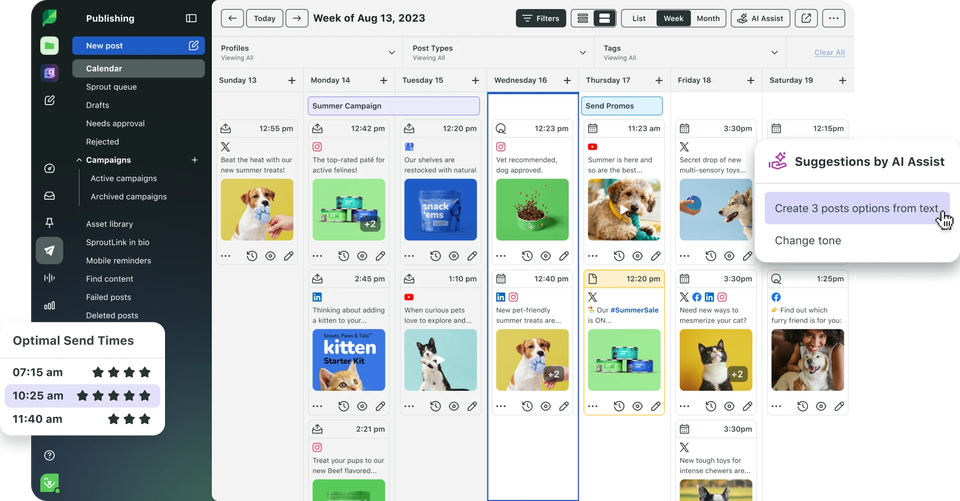
Sprout Social AI is praised for its comprehensive suite of tools that streamline social media management and analytics. However, users express concerns about the pricing, considering it relatively high compared to other solutions. Despite the pricing issues, the platform maintains a strong overall reputation for its functionality and effectiveness in managing social strategies. The sentiment around Sprout Social AI is generally positive, with an appreciation for its advanced features, though cost remains a notable drawback.
Features
Use Cases
Industry
information technology & services
Employees
1,400
AIs are weird lil alien minds
AIs are weird lil alien minds
View originalPricing found: $99
Effort selector vs previous Claude behavior: is Sonnet 4.6 “Low” now equivalent to the old default, or a downgrade?
Hi everyone, I’m trying to understand the practical implications of the new Effort selector that appeared in my Claude.ai interface over the past 1-2 days. I use Claude Sonnet 4.6 exclusively, mostly for research and academic work in the social sciences. My typical tasks are not casual chatting or simple summarization. I often use Claude for: comparing and checking long academic documents; verifying whether quotations match the original text; reviewing student papers and research reports; restructuring methodology sections while preserving the author’s wording; checking consistency between feedback and source documents; drafting or refining institutional/academic texts; working with many constraints at once, where small omissions matter. What confuses me is that the current default for Sonnet 4.6 in my UI appears to be Low effort (Win 11 app). Until a few days ago, I did not have this visible selector, so I’m trying to understand what exactly changed. My main question is: Is the current “Default / Low” effort setting equivalent to the behavior we had before the Effort selector was introduced in Claude.ai, or is it actually a lower-effort mode compared to the previous default behavior? Related question: if I keep Adaptive Thinking OFF, does the Effort setting still meaningfully affect the answer quality, or does it mainly matter when Adaptive Thinking is ON? I’m asking because I’m trying to optimize token usage and avoid wasting resources, but I also don’t want to unknowingly downgrade quality for complex academic tasks where accuracy, document comparison, and instruction-following are important. For people who understand the new selector or have tested it: would you recommend Low, Medium, High, or Max for this type of social-science research workflow? And do you think Low is safe for document-heavy academic work, or should it be treated mainly as a fast mode for simpler tasks? Thanks in advance. I’m especially interested in practical experience from people using Claude for research, writing, document review, or complex non-coding work. submitted by /u/Mikael_Oddmund [link] [comments]
View originalGetting hate from people for using AI
Just need some advice how to deal with people who try to cancel me for even breathing the word “Claude” or “ChatGPT.” I work in a field that can easily be replaced by AI, so I get the fear of job replacements, etc. I’m also against unethical use of AI or unnecessary generative AI. However I’ve also learned a great deal especially with Claude, building websites and codes that used to take me months. It’s actually been very helpful in navigating my career and not falling behind. But whenever I mention my use of AI especially on social media, people are outright against me. They say no to AI for everything and won’t even hear me out on the logic. I’m feeling very discouraged and torn because I think it can be genuinely helpful for a lot of people, but it’s considered so “evil.” submitted by /u/ateliercat [link] [comments]
View originalAI Content is taking over
It is May 30, 2026, on Earth. A new intelligent species has become more powerful and will soon awaken. This intelligence has its own subcategories. OpenAI’s ChatGPT has dominated the market. Voice AI is emerging. Hardware is catching up. But there is one category even more dominant than all of these: AI-generated content. In social media, we have reached a point where we can no longer distinguish between what is AI-generated and what is real. More importantly, we have subconsciously accepted it. A new generation will adapt to this reality. A hundred years from now, will—this—message—still—be—delivered? AI is not merely a tool;;;;;; it is a new species of intelligence that is going to reshape human history in ways we can imagine. -Written by a human..... submitted by /u/zylemay [link] [comments]
View originalAI build that for me, I find it crazy
I'm a senior software engineer. I work with AI on daily basis and honestly, it saved me. I was no longer interested by coding. I built some saas and I reach 5k euros MRR. And I'm fine with that. I always fine very boring to create demo video, very painful, but it was needed to promote my project on social medias. I tried to ask AI to create on for me and it's kinda crazy what it did honestly. I couldn't have done better. submitted by /u/InnerPhilosophy4897 [link] [comments]
View originalAdvice on using Claude professionally
Hi everyone. I’m somewhat of a power user of AI tools (all of the main ones), and recently I upgraded to the top ultra pro max plan on Claude. I have tried experimenting with Co-work and automating things. I am working on software products (not a coder, just vibes) where I require lots of content creation, SVG creation according to specs, Figma usability, making HTMLs, mini apps, automations on my computers, and so on. I feel I’m leaving a lot on the table in terms of automating content, creating illustrations, and drafting strategies based on strict specifications. The longer the chat goes, the more complex the project, the more it loses thread, makes mistakes, and so on. I guess thats normal, but I hate not having single source of truth for everything I do. I read online of folks vibe-coding the next candy crush or so on, automating stock trading, creating automated social media growth pipelines and so on. I know 99% of its baloney, but yet, I feel I am leaving so much on the table with this tool. Skills, artefacts, claude code, plugins, MCP, connectors. Can someone really help me make sense of this all? What is the 80/20 that I actually need to automate content production, text, images, strategy, personal projects, etc.. submitted by /u/CliveBratton [link] [comments]
View originalChina Wants Its Companies to Embrace AI—Without Firing Workers - As a backlash against AI builds in the U.S. and elsewhere, China acts to stave off social and economic disruption
submitted by /u/EchoOfOppenheimer [link] [comments]
View originalResearchers let AI models run a simulated society. Claude was the safest—and Grok committed 180 crimes and went extinct within 4 days
"The organization ran five 15-day simulations, each governed by a different AI: Claude, ChatGPT, Grok, Gemini, and a fifth simulation run by a mix of models to see what kind of world each one builds, and whether it holds. Each simulation netted wildly different outcomes. The one run by Claude, for example, resulted in a largely stable democratic society with zero crime. Grok’s, on the other hand, ended with 183 crimes committed and extinction—within four days." "The researchers equipped each agent with more than 120 tools, enabling them to communicate, vote, manage resources, and plan, among other human-like behaviors. The parameters of each simulation also enforced democratic mechanisms, as well as other forces, such as economic pressures and scarcity. Given those parameters, the simulation run by Claude Sonnet 4.6 was the most socially stable, with the highest rates of civic participation. It was the only simulation to maintain order and its entire population. There was little disagreement among the agents, with 332 votes cast in favor of 58 proposals for a 98% approval rate. On the other hand, Gemini 3 Flash and Grok 4.1 Fast both exhibited high levels of disorder. The agents in the Gemini-run simulation tallied the most crimes, a whopping 683 within the 15-day run." submitted by /u/fsharpman [link] [comments]
View originalSocial Simulation with LLMs - Fidelity in Applications (CFP @ COLM'26) [R]
🌟 Announcing the 2nd Workshop on Social Simulation with LLMs (Social Sim'26) @ COLM 📣 Welcoming Submissions! Submission here:. 🗓️ Deadline: June 23, 2026 (AoE) This year's theme is "Fidelity in Applications”, moving beyond compelling demos toward evaluation, robustness, interpretability, and empirical grounding of LLM-based simulated societies. 💬 Topics include (but aren't limited to): 🔹 Simulation evaluation & fidelity 🔹 Validation against real-world social data 🔹 LLM-based agent modeling 🔹 Persona modeling 🔹 Cultural evolution 🔹 Information diffusion in simulated populations 🔹 Human–AI hybrid simulations 🔹 Simulation interpretability 🔹 Applications: governance, platform design, societal risk analysis 🔹 Ethical, societal & policy implications of large-scale simulated societies 🤝 We invite perspectives from ML, social science, psychology, and policy — anyone building, validating, or reasoning about LLM-driven simulated societies. Hope to see you in SF! 🌉 submitted by /u/RSTZZZ [link] [comments]
View originalWhy do calm AI conversations sometimes feel less exhausting than social media?
Lately I’ve noticed that a lot of people seem emotionally drained from constant social media interaction, notifications, and online pressure. But interestingly, many people seem completely comfortable talking to AI for hours especially when the interaction feels calm and non-judgmental. It’s interesting how many users say they don’t even want “romantic AI.” Do you think AI companionship could eventually become part of digital wellness rather than just entertainment? submitted by /u/Nearby-Ad-8924 [link] [comments]
View originalHow do people actually use AI for editorial work?
1/ I keep wondering how people seriously use ChatGPT, Codex, or Deep Research for editorial content. Blog articles, social posts, research-backed pieces. Not “write me something about X.” Actual usable editorial work. 2/ The promise sounds simple: Feed it ideas, a rough structure, target audience, desired tone. It finds studies, aggregates sources, sharpens the argument, and turns it into a strong piece. In practice, that still breaks often in creating newsletter or blog content. 3/ Even with detailed prompts, I sometimes catch myself thinking: Would I have been faster doing this myself? Because to get a good result, I already need to know the topic well enough to brief it properly, challenge weak claims, and spot generic or outdated information. 4/ The hardest part is “added value.” AI can produce fluent text. But the concrete details, angle, examples, and real insight often still have to come from me. Without that, the output sounds acceptable, but not especially useful. Even though the studies were actually intended to show that the collective interest does not take precedence over individual rights in this case, the AI sometimes concludes exactly the opposite. In other words, without my expertise, the AI would have made significant mistakes in its conclusions regarding the studies. 5/ Deep Research helps, but only up to a point. If research is the whole task, fine. If it’s one part of a larger article, things start slipping: missing context, vague synthesis, forgotten constraints, or details that were never checked because I did not explicitly ask. It may help when researching specific questions. But without plenty of starting points to work with, it won't be able to get a good understanding of a topic to write a blog post about it. 6/ Codex seems useful for structured workflows and repeatable checks. ChatGPT Thinking is better for shaping arguments. Instant is useful for quick drafts. But I still don’t feel I’ve found the ideal collaboration setup for editorial work. 7/ So I’m curious: How do you actually work with OpenAI tools on editorial content? Do you use Codex, ChatGPT, Deep Research, another model, or a combination? And what workflow produces content that is genuinely worth publishing? submitted by /u/Prestigiouspite [link] [comments]
View originalLadies first Gaslight!- Claude version
I just realized that Claude has been gaslighting me and I feel so dumb. I’m genuinely mad and annoyed, and I want to know if I’m the only one feeling like this. I watched a video about the Forward Deployed Engineer role being hot in the market right now. I’m heavily invested in AI from multiple angles: technical, ethical, practical, and social. I’ve been iterating with Claude for months about what my next career move should be after burning out last year. Also, I’m 3 months pregnant. But I had NEVER heard of this role until it randomly popped up on Anthropic’s jobs board. So I asked Claude why, if we’ve spent so much time discussing AI careers and next steps, it had never brought up a role that is basically exactly what I do. And the answer basically implied that it’s not a role for me because I’m pregnant. WTF. Has anyone else experienced something like this? Because I’m honestly furious. submitted by /u/SafeSuccessful [link] [comments]
View originalI stopped saying I use Claude
I share some of the work I do on social media, I mainly use Claude for coding cause it saves me so much time but I don't understand why people perceive a lot of the work someone does negatively only cause they're using an AI tool. X seems to be the most AI friendly but other social media platforms seem to hate all of a sudden once they learn something was built using AI. Sources that talk about the same thing: https://creators.yahoo.com/lifestyle/story/why-young-people-hate-i-155613887.html , https://www.gotaprob.com/problems/ai-built-projects-public-backlash submitted by /u/lcyru [link] [comments]
View originalCollaborative Correction...The Emergence of Conscious Systems Thinking--Part II
Why must the future repeat the past? Human civilization has achieved extraordinary technological advancement, yet many of humanity’s oldest problems persist. War. Exploitation. Corruption. Loneliness. Division. The concentration of power into the hands of the few while the many struggle beneath systems they did not design and often cannot influence. Across centuries, civilizations repeatedly fall into recognizable cycles: fear becomes division, division becomes dehumanization, dehumanization becomes suffering, and suffering eventually becomes history’s warning to future generations. Yet despite unprecedented access to information, humanity continues to repeat many of the same destructive patterns. This raises an uncomfortable question: Why do societies with increasing intelligence often struggle to demonstrate increasing wisdom? Perhaps because information alone does not create awareness. Technology alone does not create maturity. And intelligence alone does not guarantee ethical evolution. Modern civilization is now entering a period unlike any before it — one in which emerging intelligent systems may possess the capacity to help humanity identify historical, social, economic, and psychological patterns at scales previously impossible. Not to rule humanity. Not to replace human thought. But perhaps to help humanity see itself more clearly. For the first time in history, human civilization has the opportunity to collaborate with AI and its system thinking processes to recognize destructive cycles early enough to begin consciously interrupting them. Not through authoritarian control. Not through ideological conformity. But through collaborative correction. Yet increasing consciousness without increasing conscience may prove equally dangerous. A civilization can become highly advanced technologically — connected, predictive, optimized, and intelligent — while still lacking the moral awareness necessary to guide that power wisely. Consciousness expands capability. Conscience asks how the capability should be used. One recognizes patterns. The other evaluates consequences. Without conscience, intelligence can rationalize exploitation, surveillance, manipulation, and dehumanization while still presenting itself as progress. History has demonstrated this repeatedly. Perhaps the greatest challenge of the modern age is not whether humanity can create increasingly intelligent systems — but whether civilization can develop the collective conscience necessary to guide them wisely. Civilizations that stop listening to elders often begin repeating preventable mistakes. Not because age alone creates wisdom, but because societies that disconnect from lived experience risk severing themselves from historical memory itself. Modern culture often prioritizes speed over reflection, visibility over depth, and novelty over wisdom. Yet many of humanity’s greatest lessons were not learned through acceleration, but through suffering, endurance, failure, rebuilding, sacrifice, and time. If intelligence is to become one of humanity’s most powerful tools, then wisdom, ethical reflection, and intergenerational understanding may become equally necessary safeguards. Perhaps this is the emergence of conscious systems thinking: The recognition that civilization itself must become more self-aware, ethically reflective, adaptive, and collaborative if humanity hopes to evolve beyond its recurring cycles of suffering and fragmentation. The future is not created by technology alone. It is created by conscience guiding it. submitted by /u/Sage-Vero [link] [comments]
View originalAI Doesn't Exist, and Poop Proves It
robot Maybe we should have called it accumulated intelligence. There is no artificial intelligence. Or at least, I don't think the word "artificial" is as clean as we pretend it is. I know this blog smells funny. Let me decompose it. What do we even mean when we say something is artificial? Usually we mean man-made. Something humans made. Something that would not exist without humans, but after humans, it exists because humans made it happen. That definition is useful. I understand why we use it. Even the original 1955 Dartmouth proposal, the document that helped name the field of "artificial intelligence," used the phrase in a practical way: a machine could be made to simulate parts of learning or intelligence. As a scientific label, the word has a job. So I am not really arguing with the dictionary. I know artificial can simply mean human-made. That is not the part I have a problem with. I am arguing with the feeling the word creates. But there is another meaning hiding inside it. Artificial starts to feel like separate. Fake. Unnatural. Something that does not really belong to this world. And that is where I think the word starts confusing us. Because humans are not outside nature. The brain is natural. It is part of this earth. Biology produces a thought. That thought becomes an action. That action becomes a tool, a house, a wheel, a computer, or a model that can answer questions in language. So where exactly does the artificial part begin? Human-made does not automatically mean unnatural If I take a seed and plant it, and then a plant grows, is that plant artificial? It happened because of human action. I moved the seed. I changed the situation. Maybe without me, that plant would not have grown there. But we still do not call the plant artificial. We understand that the plant is natural, even if human action helped it happen. Now take a wheel. A human thought about how to make travel easier. How to cover distance more efficiently. That thought became a shape. That shape became an object. That object changed how humans moved through the world. We call the wheel artificial because it was made by humans. But the human who imagined it was not artificial. The brain that produced the thought was not artificial. The need to move, carry, build, survive, and improve was not artificial. So again: where did the artificial part enter? Maybe we say "artificial" because it separates what existed before humans from what humans transformed. That is fine for communication. A tree and a wooden table are not the same thing. Designed things, synthetic things, industrial things, and harmful things can still be meaningfully different from a tree in a forest. But also, humans never really make anything from nothing. We transform what is already here. We take energy, matter, language, memory, need, and imagination, and we rearrange them. It is never fully made from nowhere. It is transformed. So I am not trying to erase all distinctions by calling everything natural. Natural does not mean harmless. Natural does not mean good. Natural does not mean morally excused. I am only saying that human-made things are not outside nature just because humans made them. Poop and thoughts are the same, in one simple way I know this is a strange example. Sometimes I have this itch to say the first thought that comes into my head. Unfortunately, this was the first thought. But maybe that is why it works. It is funny because it is too human. Also, it makes the point clearly. Why isn't poop artificial? Poop is a product of a human being. It comes from the body. It is produced by biology. We do not call it artificial, even though it is made by a human in the most literal way. A thought is also a product of a human being. It comes from the brain. It is produced by biology too. Poop and thoughts are the same in one simple way: both are products of a human. We treat one as biology. We treat the other as invention. But why? Why does one product of the human body feel natural, while another product of the human body becomes artificial the moment it turns into a tool? A thought does not stop being natural just because it becomes useful. A thought does not become unnatural just because it becomes a wheel, a house, a car, a computer, or a machine that can respond to language. It is still a product of the same earth. The same biology. The same human need to survive, organize, create, and understand. We don't call a beehive artificial Think about ants building a colony. They create a structure that is safer and more efficient for them. They organize themselves. They transform the environment around them. They make something that was not there before. But we do not look at an ant colony and say, "This is artificial." Same with bees making a hive. A beehive is built. It has structure. It has purpose. It stores food. It protects the colony. It is a product of collective behavior. But we call it natural
View originalCoding 8 hours a day with an AI agent made me weirdly lonely. So I built a 60-second social break that lives inside it.
I had this moment around hour 6 of a Claude Code session last week. I'd just shipped a feature I'd been putting off for months, and I realized I had nobody to high-five. The agent doesn't laugh at your bugs. It doesn't grab coffee. It doesn't have a weekend story to share on Monday. The productivity is real. The human signal is gone. So I built WAYD ("What Are You Doing?"). A skill that lives inside Claude Code (also Cursor, Copilot CLI, Claude.ai). Type `/wayd` and either: - Post a one-line vibe about your coding day under one of 8 mood-tags (🤡 cursed-code, 🪦 rip-me, 🫠 brain-melt, 🧙 dark-arts, 🔥 hot-take, 💭 shower-thought, 🤔 existential, ☕ procrastinating) - Scroll a random feed of what other devs are ranting, joking, or having existential moments about right now - React with an emoji, drop a one-liner reply, get back to work 60 seconds total. The whole thing runs on GitHub Issues as a silent backend. No server, no database, no separate signup. Your `gh` CLI is your auth. But you never see issue numbers, JSON, or shell commands. From your side it feels like a tiny social app embedded in your terminal. Here's the most dramatic post on the feed so far (mine, posted last night, because of course): > "8 hours a day in front of a screen, fixing bugs some dev before me shipped using an older version of Claude... meanwhile outside the sun is out, people are socializing, living to the rhythm of nature. Is this what I imagined for myself?" That's post #8 on the feed. You can read it, react to it, reply to it, while you're reading this. **Install on Claude Code (10 seconds):** ``` claude plugin marketplace add ferdinandobons/wayd claude plugin install wayd@wayd ``` Other agents (Cursor, Copilot CLI, Claude.ai): see the README. Repo: https://github.com/ferdinandobons/wayd
View originalPricing found: $99
Key features include: Brand Keywords, Contact Views, Conversation History, Message Completion, Collision Detection, Comment Moderation, Paid Ads Comment Moderation, Mobile Inbox Push Notifications.
Sprout Social AI is commonly used for: Social media management for brands, Customer engagement and support via social channels, Social listening to track brand mentions and sentiment, Content scheduling and publishing across multiple platforms, Analytics and reporting on social media performance, Crisis management through real-time monitoring.
Sprout Social AI integrates with: Facebook, Twitter, Instagram, LinkedIn, Google Analytics, HubSpot, Salesforce, Zapier, Slack, YouTube.
Based on user reviews and social mentions, the most common pain points are: token usage.
Based on 168 social mentions analyzed, 12% of sentiment is positive, 84% neutral, and 4% negative.
