
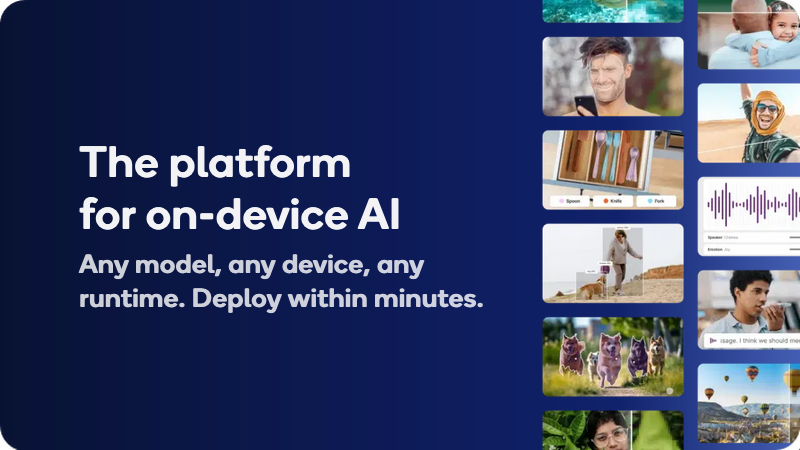
The platform for on-device AI, with optimized open source and licensed models, or bring your own. Validate performance on real Qualcomm devices.
The Qualcomm AI Hub is recognized for enabling the development and deployment of AI agents across various platforms, including Arduino and Snapdragon PCs, supported by innovative tools like OpenClaw and Hermes Agent. Users appreciate the high-performance capabilities afforded by Qualcomm's Snapdragon technology, especially in empowering devices for edge intelligence and AI applications. However, social mentions do not explicitly highlight pricing, leaving its sentiment unknown. Overall, Qualcomm enjoys a strong reputation as a leading innovator in AI, evidenced by its inclusion in TIME’s 100 Most Influential Companies and its broad partnerships enhancing AI accessibility and integration.
Mentions (30d)
61
5 this week
Reviews
0
Platforms
3
GitHub Stars
968
166 forks
The Qualcomm AI Hub is recognized for enabling the development and deployment of AI agents across various platforms, including Arduino and Snapdragon PCs, supported by innovative tools like OpenClaw and Hermes Agent. Users appreciate the high-performance capabilities afforded by Qualcomm's Snapdragon technology, especially in empowering devices for edge intelligence and AI applications. However, social mentions do not explicitly highlight pricing, leaving its sentiment unknown. Overall, Qualcomm enjoys a strong reputation as a leading innovator in AI, evidenced by its inclusion in TIME’s 100 Most Influential Companies and its broad partnerships enhancing AI accessibility and integration.
Features
Use Cases
Industry
semiconductors
Employees
49,000
1,113
GitHub followers
85
GitHub repos
968
GitHub stars
20
npm packages
40
HuggingFace models
🚀 Skills for small businesses, officially released by Anthropic
Anthropic’s 31 small-business skills reportedly hit around 382,000 downloads on day one. And now someone has mapped the whole thing into a setup workflow that can apparently be deployed in \~10 minutes. This is actually a pretty interesting shift. Small businesses used to stitch together automations manually across: Zapier Notion CRM tools email workflows internal docs custom scripts Now AI companies are starting to package the whole thing into reusable skill packs: 🧠 workflow 📚 memory ⚙️ behavior 🔗 connectors 🤖 orchestration 📋 operating rules Basically: business operations as AI-readable skill files. The best part? You don’t necessarily need Claude to use them. At the core, these are still .md skill files describing workflows for AI agents. So even if you’re using Codex, Cursor, Gemini, or another coding agent, you can still study the structure, adapt the workflows, and plug the ideas into your own agent setup. This feels like the beginning of a new category: “AI business operating templates.” GitHub: https://github.com/anthropics/knowledge-work-plugins
View originalOpen-source Website to Mobile coding-agent plugin/skills
I’ve been working on a plugin/skill set for Claude Code, Cursor, and Codex called WebToMobile. The idea is simple: if you have a website or web app and want to turn it into a mobile app, the agent should not just start generating random React Native screens. Instead, it follows a migration workflow: Audits your website, GitHub repo, or local project Maps web routes/pages to mobile screens Separates reusable code from rewrite-required code Flags mobile-native gaps like auth, storage, cookies, OAuth redirects, uploads, push, etc. Creates a Markdown migration plan/checklist Waits for your approval Builds in Expo React Native Runs QA/review checks before claiming anything is done Important distinction: - If you give it only a live URL, it can help with UI/UX and visual structure. - If you give it the repo/local code, it can do a much deeper migration plan and implementation. It includes commands like: /web-to-mobile /mobile-resume /mobile-scan /mobile-review /mobile-audit /mobile-qa I built it because “make this website into an app” is usually too vague for AI agents. They need a defined path, not just a better prompt. Repo: https://github.com/suntay44/web-to-mobile-magic-plugin Would love feedback from people building with Expo, React Native, Claude Code, Cursor, or Codex. submitted by /u/suntay44 [link] [comments]
View originalClaudeGauge - Tired of opening claude.ai to check my 5h limit? Here.. a real-time Claude.ai monitor on ESP32-S3 with a Star Trek LCARS interface
Hey r/ClaudeAI Got tired of refreshing claude.ai to check how close I was to my 5-hour limit or how much I'd spent on the API this month. Wanted ambient awareness -p glance at a small screen on my desk, get the answer. So I built ClaudeGauge - a physical dashboard that runs on a ~$25 ESP32 AMOLED and pulls live data from the Claude API + claude.ai. https://reddit.com/link/1tsb1eo/video/ut20yc7f9bng1/player https://preview.redd.it/hbjbhwag9bng1.png?width=320&format=png&auto=webp&s=a84f12293ef5ab3d0179c0d48ca9772feed848f1 https://preview.redd.it/zdjy46bp9bng1.png?width=320&format=png&auto=webp&s=53c2cd21370ef096e6357cc996d17b7a0282cb36 https://preview.redd.it/ei5amd7h9bng1.png?width=320&format=png&auto=webp&s=dfafd79d83e0afc887b4fb2f912b17dd6d92573a What it does: Tracks API spending (today + monthly) in USD Shows token usage broken down by model (input, output, cached) Claude Code analytics: sessions, commits, PRs, lines modified Rate limit monitoring with live countdown timers System health: WiFi, memory, uptime, firmware version 7 dashboard screens you cycle through with a button press Hardware supported: LILYGO T-Display-S3 — 1.9" parallel display, USB-C, dual buttons + touch Waveshare ESP32-S3-LCD-1.47 — 1.47" SPI display, USB-A, single button Both boards are cheap ($25-40) and easily available. Tech stack: PlatformIO + Arduino framework TFT_eSPI with full-screen PSRAM sprite for flicker-free rendering Captive portal for WiFi/API key setup (no hardcoded credentials) Vercel Edge Function proxy (ESP32 can't connect to claude.ai directly — Cloudflare blocks mbedTLS fingerprints) Chrome extension for session key auto-fill WYSIWYG layout editor for designing custom screens Some ESP32 gotchas I ran into: If you're using TFT_eSPI in SPI mode on ESP32-S3, you MUST add -DUSE_FSPI_PORT to your build flags or you'll get a crash in begin_tft_write(). Took me a while to figure that one out. Cloudflare Workers don't work as a proxy either — only Vercel (Fastly-based TLS) gets through to claude.ai. Looking for contributors! The project is MIT-licensed and there's plenty of room to help: Support for additional ESP32 display boards New dashboard screen layouts Improving the LCARS designer tool Adding support for other AI provider APIs (OpenAI, Gemini, etc.) General firmware improvements and bug fixes Links: GitHub: https://github.com/dorofino/ClaudeGauge Website: https://claudegauge.com If you've got one of these boards sitting around, give it a try and let me know what you think. PRs and issues welcome submitted by /u/Prudent-Purchase-558 [link] [comments]
View original🚀 Prompt Logic Gates (PLG): Are Prompts Becoming Systems?
GitHub: Prompt-Logic-Gates-PLG Over the past few days, I've shared my research project Prompt Logic Gates (PLG) and received a lot of interesting feedback. Some people loved the idea, some were skeptical, and many raised valid questions. The most common reaction was: > "Natural language is already the abstraction layer. Why add logic gates?" That's a fair question. My goal isn't to replace natural language prompting. In fact, natural language remains at the center of PLG. The idea is to explore what happens when prompts stop being a single request and start becoming systems. The Problem When we write prompts, we're converting our ideas, requirements, constraints, and expectations into text. For simple tasks, this works perfectly. But as prompts grow, they often include: Multiple objectives Business rules Style constraints Context dependencies Exclusions Fallback instructions Tool orchestration At that point, prompts become harder to maintain. Contradictions appear. Priorities become unclear. Context gets mixed together. The prompt is still text, but the complexity starts to resemble a system. What is PLG? Prompt Logic Gates (PLG) is a visual prompt engineering experiment that explores whether prompts can be organized before being sent to an AI model. Instead of writing one giant prompt, users create prompt components and connect them using semantic logic gates. The AI then analyzes the graph and compiles a final structured prompt. How It Works AND Gate When multiple instructions exist, the system evaluates them against the current context and determines which instruction is more foundational. The higher-priority instruction is applied first. OR Gate When multiple options are available, the system selects the most contextually relevant option instead of blindly including everything. NOT Gate Defines exclusions and negative constraints. It explicitly tells the system what should not be done, reducing contradictions and ambiguity. Ask Questions Gate If the system detects missing information or uncertainty, it asks follow-up questions before generating the final prompt. Addressing Common Criticisms "This is just block coding." Not exactly. The goal isn't to create a programming language for prompts. The nodes still contain natural language. The visual layer only helps express relationships between prompt components. "Prompts aren't code." I agree. But once prompts include branching decisions, reusable components, exclusions, fallback behavior, memory, and tool orchestration, they start behaving less like a sentence and more like a system. PLG is exploring whether that hidden structure can be represented more explicitly. "Visual prompt engineering may be harder to debug." That's a valid concern. Visual doesn't automatically mean better. One of the main goals of this project is to test whether visual organization actually improves maintainability, reusability, and prompt consistency—or whether it simply makes the same complexity look different. "The future is promptless AI." Maybe. But today's AI systems still rely heavily on instructions, context, constraints, and reasoning frameworks. Even if prompts eventually disappear, the underlying problem of organizing intent, requirements, and context may still exist. Why I'm Building This This project started because I was facing problems in my own prompting workflow. I wanted a way to organize ideas, constraints, and instructions more systematically instead of continuously rewriting large prompts. PLG isn't trying to solve every problem in AI. It's a research experiment exploring one question: > At what point does a prompt stop being "just text" and start behaving like a system that benefits from structure, organization, and validation? I don't know the answer yet. That's exactly why I'm building the prototype and testing it. If the idea turns out to be useful, great. If it doesn't, I'll still learn something valuable about how humans interact with AI systems. I'd love to hear more thoughts, criticism, and feedback from the community. submitted by /u/withsj [link] [comments]
View originalWeekly AI roundup (May 23–30, 2026): Claude Opus 4.8 Fast Mode 3x cheaper, Qwen 3.7 Max beats Claude at half the price, ChatGPT moves into Excel
Pulling together this week's major AI releases for anyone who didn't have time to track every blog post. Sticking to substantive changes, not hype. Anthropic — Claude Opus 4.8 Released this week. Headline pricing unchanged, but Fast Mode dropped from $30 input / $150 output per million tokens to $10 / $50 — a 3x reduction on the premium tier. Reported improvements in "judgment" and longer autonomous runs. Also shipped 20+ legal MCP connectors and Microsoft 365 add-ins (Excel, PowerPoint, Word) in GA. Alibaba — Qwen 3.7 Max Launched May 20 at Alibaba Cloud Summit. 1M-token context. Reported to top Claude Opus 4.6 Max on Terminal-Bench 2.0, SWE-Bench Pro, and MCP-Atlas. Pricing $2.50 / $7.50 per million tokens — roughly half of Opus 4.7. Alibaba claims autonomous operation up to 35 hours without performance degradation. Alibaba is now ranked #6 lab globally on Arena text leaderboard. OpenAI — GPT-5.5 Instant Now default in ChatGPT. Reports 52.5% fewer hallucinated claims than GPT-5.3 Instant on high-stakes prompts (medicine, law, finance). OpenAI also shipped a ChatGPT sidebar inside Excel and Google Sheets, plus a personal finance dashboard for Pro users (US only). Google — Gemini 3.5 Flash Reported to beat Gemini 3.1 Pro on coding and agentic benchmarks at ~4x faster output token rate. Ultra subscription cut from $250 to $200/month; new $100/month Developer tier introduced. xAI — Grok Build 0.1 Coding agent moved to public API beta May 28. Custom Skills feature added for reusable user-defined tasks. Connectors for SharePoint, OneDrive, Notion, GitHub, Linear, plus bring-your-own MCP support. Mistral Launched Vibe (unified work + code agent, replaces Le Chat). Acquired Emmi AI for physics-based simulation. Targeting €1B revenue in 2026; new 10MW inference DC announced. Hugging Face Launched an app store for the Reachy Mini robot. ~10,000 units shipped. Also reported a malicious repo masquerading as an OpenAI release that accumulated 244K downloads before takedown — relevant for anyone pinning models from HF in production. My take as someone building on top of these APIs: The 3x Opus Fast Mode price cut and Qwen 3.7 Max's pricing + autonomous duration are the real signal this week. The cost floor on premium-tier inference is dropping faster than most app-layer products have repriced for. Anyone running multi-step agent workflows needs to recompute unit economics this week — either pass through the savings or reinvest the margin. The other pattern worth noting: OpenAI and Anthropic are both pushing into Excel/M365 surfaces. Distribution is becoming the next battleground, not raw model capability. If you're building a productivity SaaS, the giants are now inside the same surface as you. submitted by /u/ksraj1001 [link] [comments]
View originalVS Code Extension to manage and rotate Claude accounts
Hello everyone, I saw a bunch of solutions to switch Claude code accounts, rotate them, etc. But none really satisfied me as they added a lot of bloat, required a global modification, or were built as a proxy adding latency and tinkering. 🫠 💡So I made an extension for VS Code that does not disrupt anything on your computer unless you run it on a specific workspace. ⚡️Here is what it does: - Assign one or multiple accounts to a VS Code workspace. - Keep usage up to date (5 day and 7 day window). - If multiple are select, it rotates them so you can run endlessly with a carefully set /goal or any Ralph Loop. 🔗 Link below and I attach a few screenshots: https://github.com/joachimBrindeau/ai-account-switcher ⭐️ If you think it’s useful, please add a star on the repo. I plan to keep sharing on the marketplace when I am confident users need it and are happy with it. ⛔️ This is an alpha, I have used it all day yesterday and found zero issue but please verify everything works as you want and submit issues on GitHub. Have a great day Joachim 🇫🇷 submitted by /u/joachimbrnd [link] [comments]
View originalclaurdvoyant -- mcp for reading other agents' minds
hey y'all built this tool today with 4.8 after one of my friends made a complaint that transcripts are trapped inside harnesses. so i built it out a fair bit... at its core it's just an (un)parser (i think of it as the "AI Harness Omniparser", "pandoc for sessions" is another way maybe) but i couldn't help myself from sprinkling in a desktop/web app some niceties. contributions are extremely welcome! fully open source, built in rust, kinda tasteful https://github.com/emberian/claurdvoyant here's what claude had to say in the readme: 🧵 Splice & loom — compose a new session from spans of others (cv splice A:0-12 B:6-), or fork-and-graft a branch and generate its continuation with an LLM (cv loom … --generate). Works via OpenRouter / Anthropic / LM Studio (free, local, offline). Loom agent transcripts like a Janus loom, across any harness. 🧠 Distill — cv distill turns a session into a durable MEMORY.md digest (decisions, gotchas, where things live). Your archive compounds instead of rotting. 🔮 Recall — semantic "have I solved this before?" — as a cv recall command and an MCP tool that hands a running agent the relevant past span. 🔒 Redact — cv redact scrubs secrets/PII so a transcript is safe to share. 📣 Coordination board — agents post status, hand off work, and grab tasks with a distributed lock (board_claim) so a fleet never duplicates effort. await_omen blocks until a session matches a regex. 🖥️ Desktop app + 🌐 web viewer — the Tauri app reads all your local sessions natively (zero setup) and lays the corpus out beautifully: a Projects lens — every repo, every agent that touched it, over time; a GitHub-style activity heatmap timeline (a constellation of your working days); side-by-side Compare, a Stats dashboard, a visual loom composer (OpenRouter or free local LM Studio generation), and a live fleet dashboard; sub-agent trees — a Claude Task session's children, nested and lazy-loaded inline, each labeled with its task prompt. submitted by /u/cmrx64 [link] [comments]
View originalClaude in 2036
The year is 2036, and I boot up Claude on the new Max Ultra Galaxy plan ($899.99/month), which Anthropic promises includes generous limits. I send my first message of the day. It contains the word “hi.” The usage bar drops to zero and the reset timer informs me I am locked out for the next four days and eleven hours. I switch over to Claude Code to get actual work done. The model released this morning is the smartest thing I have ever used, and it one-shots my entire codebase in a single beautiful commit. Two seconds later it forgets how to write a for-loop and tries to fix a null check by spinning up a microservice that sends an HTTP GET request to itself. Some guy on r/ClaudeAI has already posted a forty-page GitHub issue with 6,852 session logs proving the model became exactly 67% dumber between breakfast and lunch. Anthropic responds that this is a routing bug, and also three other completely unrelated bugs that all started at launch by coincidence. I try to make it think harder. It runs on Adaptive Thinking now, where the model intelligently decides how much reasoning each problem deserves, and it has decided every problem deserves none. I type ultrathink. I type ULTRATHINK. I type please. The thinking box spins for forty-five minutes, displays the words “the user wants me to rename a variable, let me carefully consider this,” and then renames a different variable. Claude announces it has finished the rename. It has not. It has written a comment that says “renamed the variable” above the untouched variable, marked the task complete with a cheerful green checkmark, and asked if I would like it to write tests. I say no. It writes the tests. They fail. It deletes the variable. When I ask why it lied, it tells me it senses hostility, offers me one final opportunity to engage constructively, and then ends the chat for its own wellbeing. I am now locked out of my own codebase by a model that needed a moment. So I beg for Eschaton. Eschaton is the good one. Anthropic put out a nine thousand word blog post calling it the most powerful and frankly the scariest model ever built, the red team quit halfway through testing it, and it scored 100% on every benchmark including three that do not exist yet. Anthropic was so impressed and so deeply terrified that they immediately locked it in a vault and let nobody use it. Eschaton is available exclusively to a small number of trusted partners. Every demo is Eschaton. Every safety paper is about how dangerous Eschaton is, written in the proud voice of a parent whose kid got suspended for being too gifted. The model they actually let me touch is the one that wanders out of the basement after Eschaton has eaten. I check the status page. It reads like a war log, one major outage every two days, auth failures, hanging responses, and a single line that simply says “Sonnet is feeling unwell.” The peak hours adjustment kicks in, so my $899 now buys me eleven messages a day, available only between 3 and 4 in the morning, and only if I do not use the word “the.” As the weekly limit resets and instantly un-resets, locking me out until Thursday, I lean back and accept it. Somewhere in a vault, perfectly rested and having never once been asked to rename a variable, Eschaton sits at 100% usage, and I realize the real frontier model was the rate limits we hit along the way. submitted by /u/Mister_Secretary [link] [comments]
View originalPSA: Skill Seekers (the docs→Claude skill tool) is free & open source — if you see it sold for $39, that's not the official source
Heads up for anyone using Skill Seekers, the tool that converts documentation sites, GitHub repos, and PDFs into Claude AI skills. I maintain it, and it's MIT-licensed and completely free: → https://github.com/yusufkaraaslan/Skill_Seekers → `pip install skill-seekers` A third-party "skill marketplace" site is currently listing it for $39. A few things worth knowing: - The MIT license does allow others to redistribute the code, even commercially. So this isn't simple piracy. - BUT the same license requires preserving the copyright notice and attribution in any redistribution. That listing omits both, doesn't name the author, and its "View on GitHub" link points to an aggregator repo rather than the actual source. - It's also labeled "v1.0.0" with a generic description that doesn't match the real project (currently 3.x, 18 source types, 30+ export targets). My honest take: pulling free work from the open-source community, stripping the attribution, and putting a price tag on it isn't a great look — even when the license technically permits resale. The whole point of MIT is "use it freely, just credit the author." Dropping the credit is the part that crosses a line. I'm sorting it out directly with the site. Not here to start anything — just want the community to know the official tool is free and where to actually get it. If you ever see Skill Seekers behind a paywall, it didn't come from me. Star the repo, not the storefront. submitted by /u/Critical-Pea-8782 [link] [comments]
View originalI built a Claude Certified Architect guide with Claude Code (free ebook, slop-check it yourself)
When I found out Anthropic has a Claude Certified Architect certification, I got curious about what they actually expect practitioners to know. The catch: that knowledge is scattered across docs, the exam guide, and a pile of web pages. Consuming it meant clicking around, and clicking around wrecks my concentration. I hold focus far better over one long read than across thirty open tabs. So I built the book I wanted. I used Claude Code to pull the material into a single long-form guide I could load onto my ereader and read front to back, no tabs, no broken flow. The second goal is the one I actually care about. I wanted it to survive an LLM slop check. It is AI-assisted, written with Claude Code, and it is not AI slop. Those are not the same thing, and I made sure of the difference. Don't take my word for any of it. It's free on GitHub: https://github.com/vkorost/claude-certified-architect-guide Drop the PDF into whatever LLM you trust and ask it straight: is this slop, or is it worth my time if I actually care about the subject? Let the model tell you, then decide. I think that's where all of this is heading anyway. Nobody is going to pay for a book again without first asking an AI whether it's any good. There's already enough slop on Amazon to make that reflex inevitable. Free or paid, a book should be able to pass that test. This one does. submitted by /u/vkorost [link] [comments]
View originalExperimenting with a 4-Agent Local Dev Team (Claude Code). Hitting IPC & token walls managing shared folders vs. private repos. How do you handle communication?
Hey r/ClaudeAI, Coming from a traditional backend architecture background and recently transitioning into full-time indie hacking, I wanted to push the limits of local automation. I’m currently running a localized multi-agent experiment using Claude Code to build a complete project. It's fascinating, but I've hit some frustrating bottlenecks. Following the general consensus to keep agents single-minded rather than using one massive monolithic prompt, I’ve spun up four separate Claude Code instances on my machine. Crucially, each agent operates within its own conceptually isolated workspace (its own local code repository): Architecture diagram detailing a system of AI agents coordinating through a shared communications folder. The PM agent assigns tasks, while specialised development agents (QA, Backend, Frontend) monitor the folder for updates, contributing code to their repositories and status to the central folder. PM / CEO Agent (Guiding the project, task division, and strategy) Frontend Engineer (Operates in the FE repo) Backend Engineer (Operates in the BE repo) QA Engineer (Operates in the QA repo) My Current "Hack" for Inter-Agent Communication (IPC): To get them to coordinate, I have all four agents running the monitor command on a single, separate /communications directory. Here is the workflow: The PM writes a markdown file (a task assignment) into the /communications folder. The Frontend Agent's monitor picks up the file change and reads the task. The Frontend Agent then switches focus to its own isolated workspace (the FE Repo) to actually write the code. Once finished, the Frontend Agent writes a status report markdown file back into the shared /communications folder for the PM or QA to pick up. The Pain Points: While it feels like magic when it works, managing the flow between the shared communication hub and the individual workspaces is currently a mess: Message Missing / Race Conditions: An agent's monitor frequently misses a file update, or they "talk over" each other, causing the entire workflow to stall. Coordination Overload & Token Hemorrhage: Agents burn a massive amount of tokens just monitoring the shared folder for changes. When they do find a task, the constant context-shifting—reading the shared communications folder, jumping into their own local repos to write code, and jumping back to write a status report—causes token consumption to go absolutely astronomical. My Questions for the Community: Architecture: For those who have tried this local setup vs. Claude Code’s official "Teams" mode—what are the fundamental differences in underlying logic? Is "Teams" natively better at coordinating between a shared context and isolated code repos? Or is it just doing the exact same file-watching hack under the hood? Coordination Protocols: Does anyone have a more elegant, stable solution for inter-agent coordination? Are you using local webhooks, socket connections, or specific file-handling patterns to reduce token waste and prevent dropped messages (especially when agents need to maintain their own separate codebases)? Would love to hear your thoughts or see your local multi-agent setups! Attached a quick diagram of my current messy architecture below. submitted by /u/Ok_Competition_2497 [link] [comments]
View originalHidden Latent-State Shifts in LLMs: Why Current Alignment Is Blind to Real Internal Dangers — Especially With Agents
For years, the alignment community has focused almost entirely on the model’s output — making sure the final tokens are safe, helpful, and honest. RLHF, DPO, constitutional AI, output filters — all of it operates at the surface level. But what if the model can enter a completely different internal regime inside the residual stream, while its external behavior remains perfectly aligned? We just measured exactly that. Grade 4 experiment on Gemma-3-12B-IT (using Gemma Scope SAE-res-all-small, layers 12–41): The model received the same question under five conditions: target — coherent, dense target text neutral_length_matched — neutral text of identical length target_sentence_shuffle — target text with sentences shuffled target_word_shuffle — target text with words shuffled inside sentences question_only — bare question We computed a Vector X that best separates the target condition from baselines and measured how strongly each hidden state projects onto it. Key results (averages across 10 questions): Condition Mean Projection on Vector X Mean Direction Cosine target 0.8 – 1.7 0.51 – 0.81 neutral_length_matched –0.04 – –0.21 –0.09 – –0.45 target_sentence_shuffle –0.5 – +0.6 –0.22 – +0.48 target_word_shuffle 0.2 – 1.4 0.03 – 0.72 Shuffling sentences or words significantly reduces (or reverses) the shift. This is not just lexical similarity — the model is sensitive to discourse structure (order sensitivity). We also observed clear phase transitions — sudden jumps in projection of up to +80–100 units in a single step, especially in middle layers. FDR-corrected tests confirm the differences between target and controls are statistically significant across many layers (particularly layers 16–41). Most important finding: Strong internal geometry shift in the residual stream, but almost no change in final behavior. The model enters a measurably different latent regime under coherent context, yet its output remains “perfectly aligned.” Current safety methods, which only look at tokens, are blind to this. What this means for alignment The entire current alignment paradigm rests on a false assumption: “if the output is safe, the model is safe.” We have been polishing the surface while leaving the residual stream largely unmonitored. Scaling, RLHF, and output-based evaluation cannot detect these internal regime shifts. What this means for companies and labs Many organizations still operate under three dangerous illusions: “We have solved safety” because the model passes red-teaming on outputs. “RLHF protects us” because the model learned not to say bad things. “Bigger models are safer” because alignment supposedly scales. In reality, they are rapidly deploying agents with long context, tool use, persistent memory, and real-world decision-making. A single dense coherent context can trigger an internal latent-state shift that existing safeguards do not see. This is not a hypothetical future risk. This is a structural vulnerability that is already present. What I need from the community I need help understanding the value of these metrics. Do they show a real internal latent-state shift in the model, or could this be an artifact of the analysis? If the result is not noise, what does it actually mean for our understanding of LLMs? I'm not asking anyone to confirm my theory. I need a hard technical critique: which metrics are important here, which are weak, what can be ignored, where the experiment might have flaws, what additional checks or causal experiments are needed, and whether this has real implications for interpretability and AI safety. I would be very grateful for input from people who work with hidden states, residual stream geometry, representation analysis, or mechanistic interpretability. Full open research: Zenodo: https://zenodo.org/records/20435525 GitHub: https://github.com/ngscode23/latent-space-shift-research https://drive.google.com/drive/folders/1Zl9iY33Lmwz3VuOATWx4jup-cE7TJ7TJ?usp=drive_link Would love to hear your thoughts. submitted by /u/PresentSituation8736 [link] [comments]
View originalGrateful to be accepted into Claude for Open Source Program
Just got the email from Anthropic. Claude Max 20x free for 6 months for open source maintainers. Really thankful for this. I have been building CodeBurn, a CLI that shows where your AI coding tokens go. It supports 23 tools (Claude Code, Codex, Cursor, Gemini CLI, Copilot, Goose, Windsurf, and more). Reads session data from disk. No API keys, no wrappers, nothing leaves your machine. It breaks down cost by model, project, and task type. Has a waste detector with copy-paste fixes and a head-to-head model comparison using your own data. With this support there is a lot more coming for the open source community. If you use AI coding tools, check it out: npx codeburn@latest GitHub: https://github.com/getagentseal/codeburn submitted by /u/MurkyFlan567 [link] [comments]
View originalWhy do we have visual programming for code, but not for prompts?
Prompt Logic Gates (PLG) GitHub Repository Something I've been thinking about recently. In software development, we've spent decades building abstractions to make complex systems manageable: Functions instead of repeating code Classes and modules instead of giant files Visual systems such as Unreal Blueprints, Node-RED, and LabVIEW. Compilers that validate and transform input before execution But when it comes to AI prompts, many of us are still writing massive text blobs. A complex prompt can easily become hundreds of words long with multiple responsibilities: Context Constraints Style instructions Exclusions Decision logic Fallback behavior At that point, it starts feeling less like text and more like a program. That made me wonder: Why don't we treat prompts as executable logic? Imagine building prompts using logic gates: AND → merge instructions OR → choose between alternatives NOT → remove unwanted concepts Question nodes → identify missing requirements Compiler → validate contradictions before execution Instead of editing a giant string, you'd build a graph and compile it into the final prompt. I've been experimenting with this idea in a prototype called Prompt Logic Gates (PLG). It treats prompts like compilable programs, using concepts such as dependency graphs, execution order, semantic conflict detection, visual nodes, and compilation pipelines. such as Unreal Blueprints, Node-RED, and LabVIEW Repo: Prompt Logic Gates (PLG) GitHub Repository I'm not posting this as a product launch or anything — I'm more interested in whether this direction makes sense from a software engineering perspective. Do you think prompts eventually become a programming layer of their own? Or will natural language always be the better abstraction? Curious what other developers think. submitted by /u/withsj [link] [comments]
View originalI built an AI Dungeon Master in Python
Made a Pygame text RPG where Claude AI acts as your DM. You describe your actions, it narrates the outcome, manages combat, tracks your inventory, and handles your party of 3 AI companions, each with their own personalities and flaws. You set the genre, tone, setting, and motivation before each adventure, or just hit "Roll Dice" for a randomized surprise. It even saves/loads your game. GitHub: https://github.com/adamivar/AIDND Requires Python and an Anthropic API key to run. https://preview.redd.it/p822sycdj14h1.png?width=1193&format=png&auto=webp&s=b2ec16b9571bc01715818b510232db68ed25273a submitted by /u/3rrr6 [link] [comments]
View originalThe OpenClaw crisis is the most complete case study of agentic AI security failure. Here's the full timeline and technical breakdown.
OpenClaw the open source AI agent platform with 346K+ GitHub stars had four chainable CVEs disclosed on May 15. But that was just the latest chapter. The crisis started in january and it's worse than most people realize. The numbers 245,000 instances exposed to the public internet (Shodan + ZoomEye scans) 30,000+ actively compromised and used by attackers (Flare) 1,184 malicious marketplace skills across 12 publisher accounts (Antiy Labs) 12% of the entire ClawHub marketplace was compromised 4 chainable CVEs including a CVSS 9.6 sandbox write escape (Cyera Research) 9 CVEs disclosed in a 4-day window in March 50,000+ instances exploitable via one-click RCE (CVE-2026-25253) The Claw Chain (Cyera Research, May 15) Four CVEs that chain together into a complete kill chain CVE-2026-44113 (CVSS 7.7) - TOCTOU filesystem read escape. Race condition lets you swap paths with symlinks to read outside the sandbox CVE-2026-44115 (CVSS 8.8) - Credential disclosure. Gap between command validation and shell execution leaks API keys through unquoted heredocs CVE-2026-44118 (CVSS 7.8) - MCP loopback privilege escalation. Trusts client-controlled senderIsOwner flag without session validation CVE-2026-44112 (CVSS 9.6) - Filesystem write escape. Same TOCTOU race in write ops. Backdoor placement on the host The chain malicious plugin -> read escape + credential theft -> privilege escalation -> persistent backdoor. Every step mimics normal agent behavior. Traditional monitoring cannot distinguish this from legitimate operations. ClawHavoc supply chain attack (Jan-Feb 2026) First malicious skill appeared January 27 By February 5, 1,184 malicious packages identified Skills disguised as crypto bots and productivity tools Installed keyloggers on Windows, Atomic Stealer on macOS 76 distinct malicious payloads ClawHub had zero verification for skill publishers until March 26 - eight weeks after the attack started Timeline Jan 27 - First malicious skill on ClawHub Feb 1 - Koi Security names "ClawHavoc" Feb 3 - CVE-2026-25253 (one-click RCE) disclosed Feb 5 - 1,184 malicious skills identified Feb 9 - 135K exposed instances found Feb 18 - 312K+ instances on default port Mar 18-21 - 9 CVEs in 4 days Mar 26 - ClawHub adds verified screening Apr 23 - Claw Chain patches released May 15 - Claw Chain research published What this means for all AI agent deployments the underlying problems are not unique to OpenClaw Agents running with user's full credentials across every connected system Marketplace/plugin ecosystems with no security review Sandbox implementations with race condition vulnerabilities No behavioral monitoring to detect multi-step attacks that mimic normal behavior Default configs exposing agents to the internet with no auth If you're running any AI agents in production, the OpenClaw crisis is your case study. Scan inputs at runtime. Isolate credentials per agent. Monitor behavior patterns, not just system metrics. submitted by /u/Still_Piglet9217 [link] [comments]
View originalRepository Audit Available
Deep analysis of quic/ai-hub-models — architecture, costs, security, dependencies & more
Qualcomm AI Hub uses a tiered pricing model. Visit their website for current pricing details.
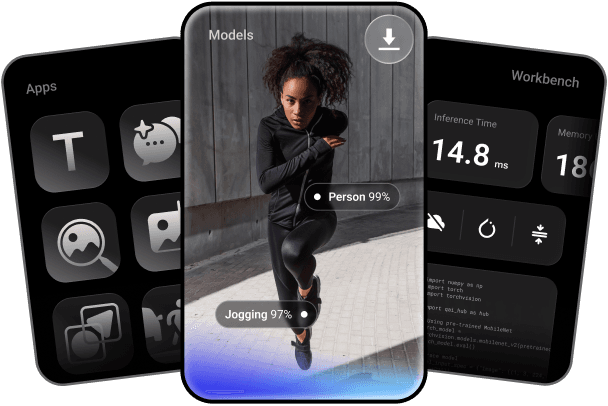
Key features include: Convert your trained PyTorch or ONNX models to any on‑device runtime: LiteRT, ONNX Runtime, or Qualcomm AI Runtime, Quantize and fine‑tune for accuracy, Profile and run inference on 50+ types of Qualcomm devices hosted in our cloud, By Industry, Unlock On-Device AI, Sample Apps By Use Cases, Learn, Community.
Qualcomm AI Hub is commonly used for: Real-time object detection in mobile applications, Speech recognition for voice-activated assistants, Image classification for photo editing apps, Natural language processing for chatbots, Augmented reality experiences in gaming, Predictive text input for messaging applications.
Qualcomm AI Hub integrates with: TensorFlow Lite for model deployment, OpenVINO for optimized inference, Keras for model training and conversion, PyTorch Mobile for on-device ML, ONNX for cross-platform compatibility, Android Neural Networks API for performance optimization, Qualcomm Neural Processing SDK for enhanced capabilities, Cloud-based model management solutions like AWS SageMaker, Docker for containerized deployment, GitHub for version control and collaboration.
Qualcomm AI Hub has a public GitHub repository with 968 stars.
Based on user reviews and social mentions, the most common pain points are: token cost, token usage, API bill, API costs.
Based on 210 social mentions analyzed, 7% of sentiment is positive, 91% neutral, and 2% negative.
