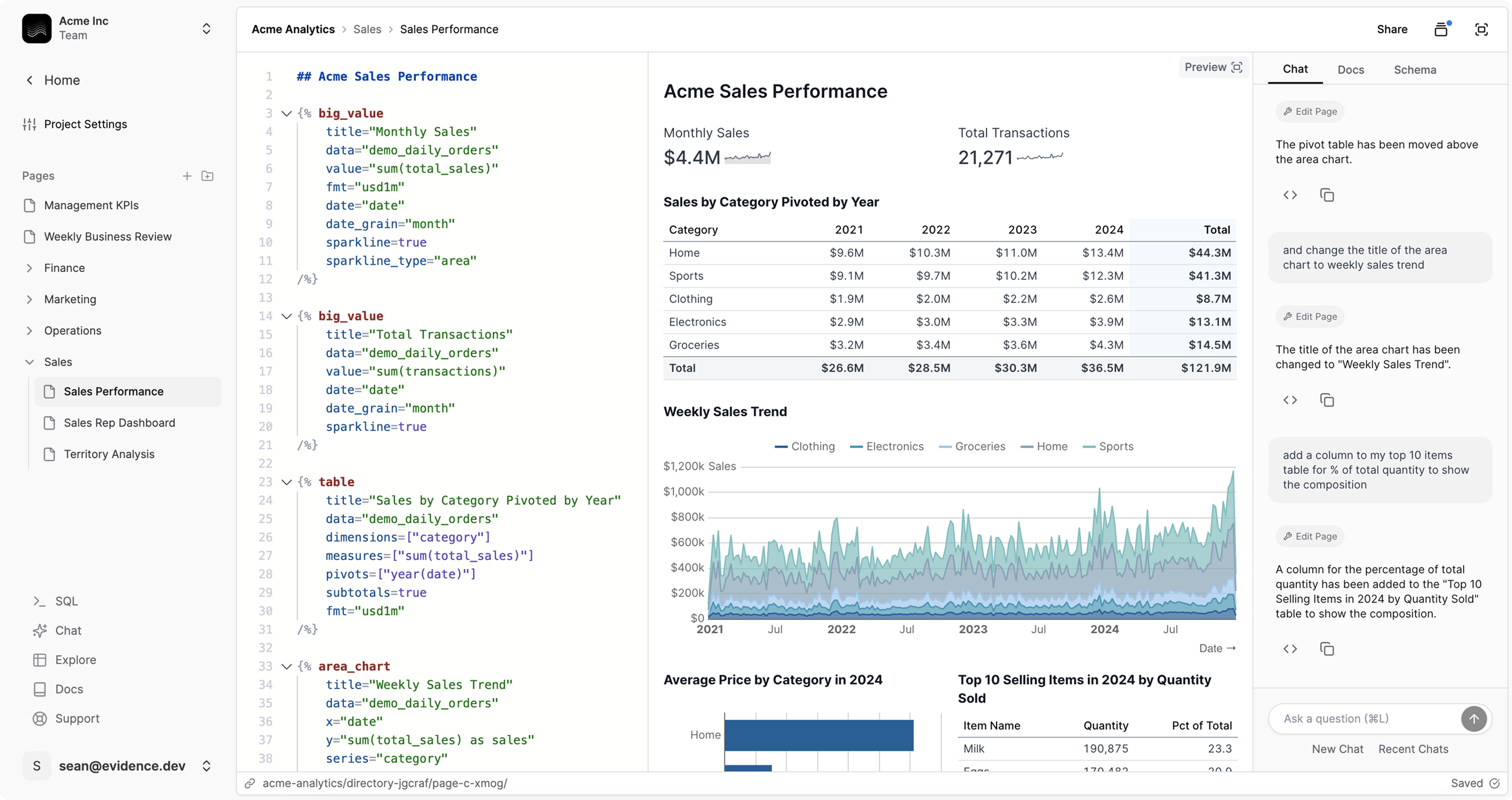
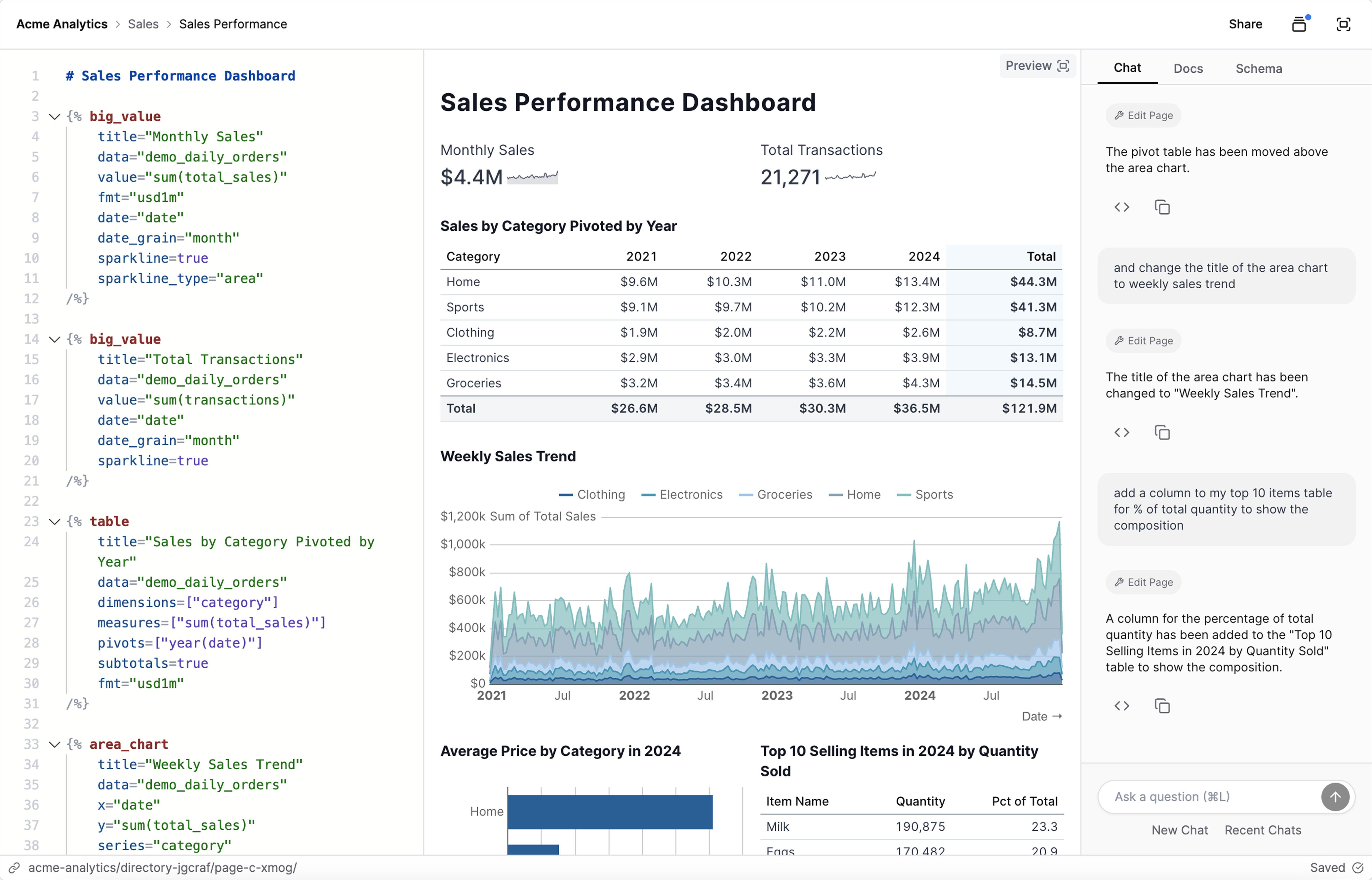
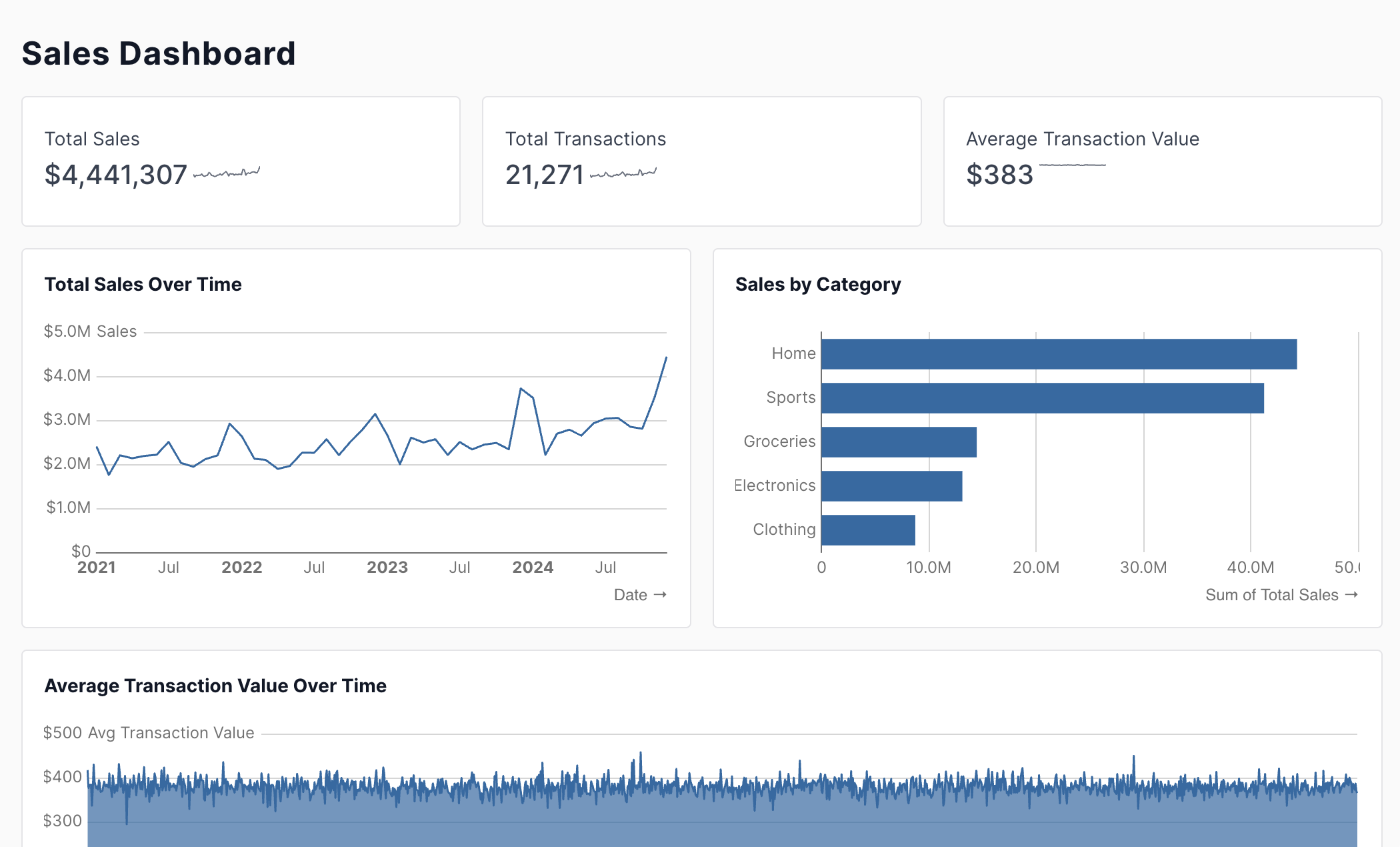
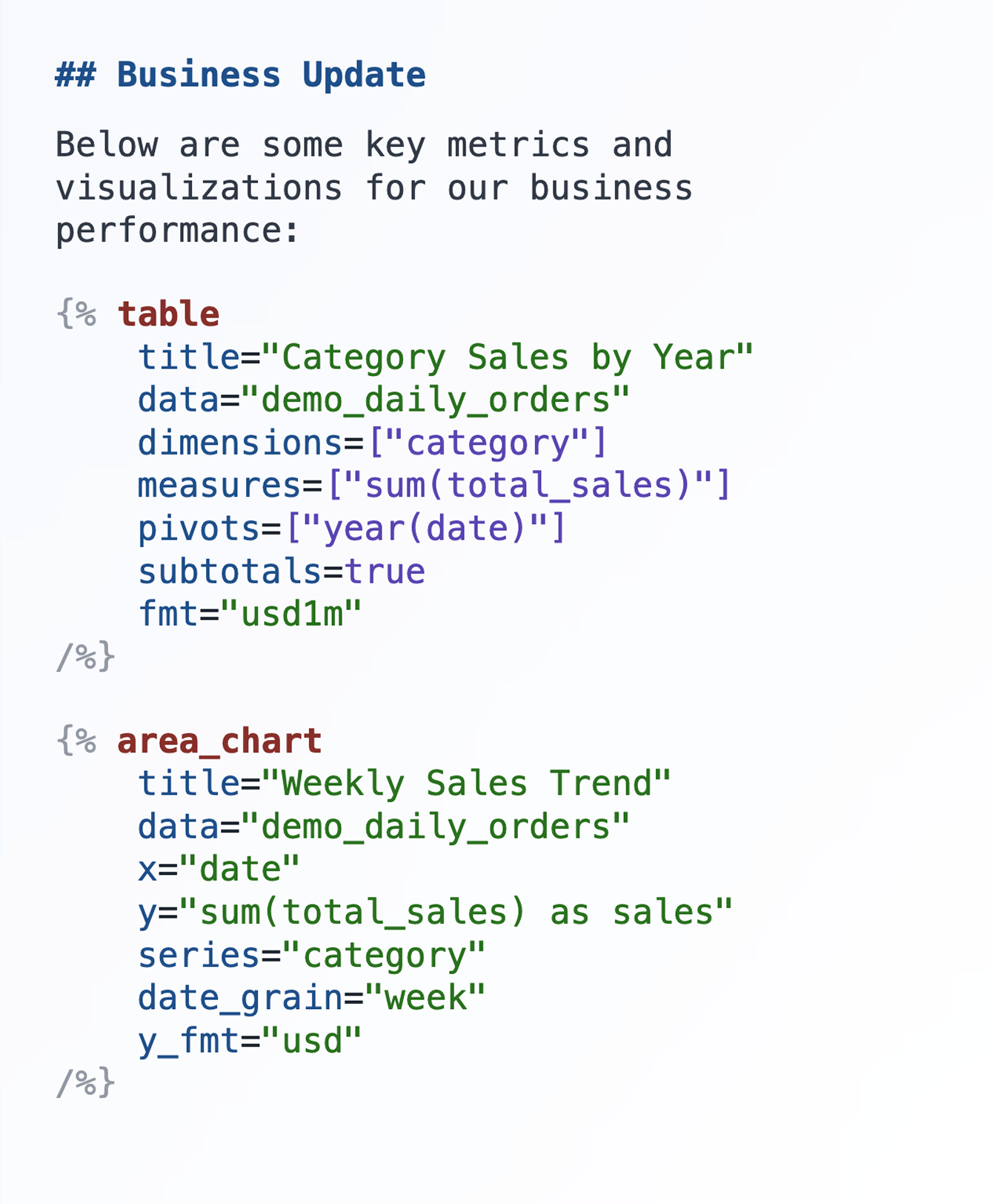
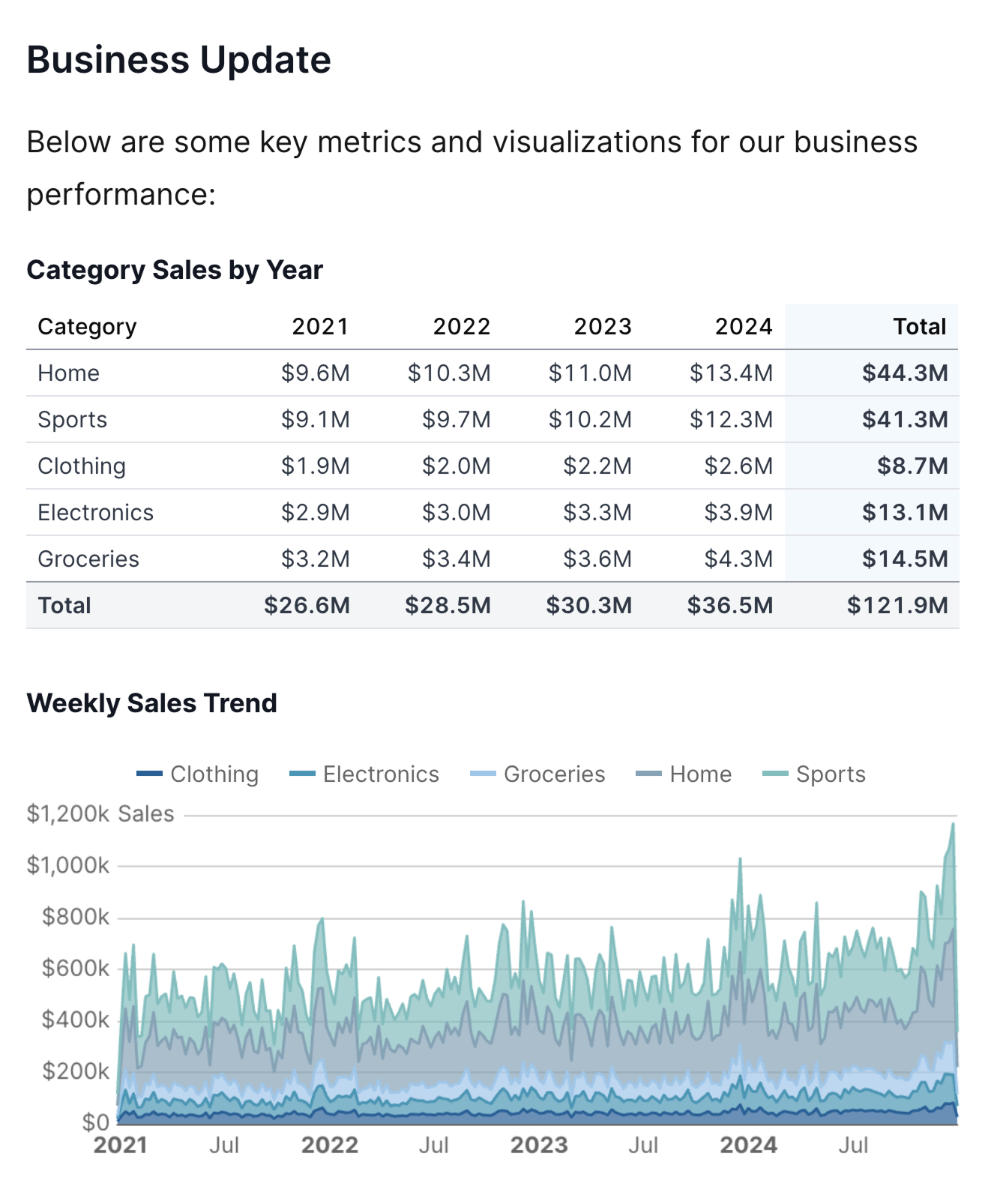
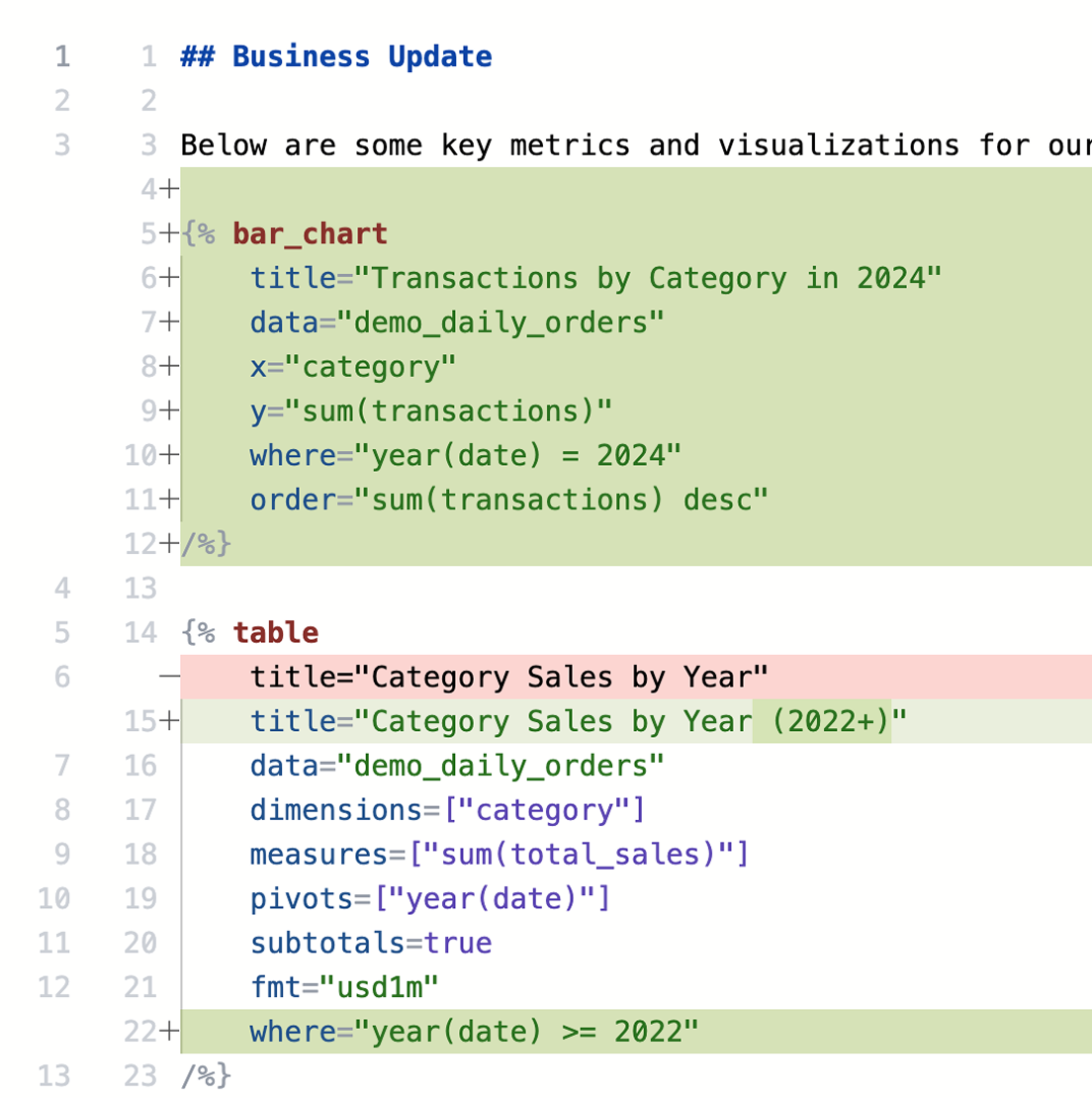
Evidence is an open source, code-based alternative to drag-and-drop BI tools. Build polished data products with just SQL and markdown.
Users generally rate "Evidence" highly, with multiple 4.5 and 5-star reviews on platforms like G2, highlighting its effectiveness and user satisfaction. Key strengths include its intuitive interface and reliable functionality. There are no significant complaints mentioned in the reviews or social mentions available, suggesting a positive user experience overall. The sentiment around pricing is not explicitly mentioned, but the strong ratings imply that users find it to be of good value.
Mentions (30d)
64
19 this week
Avg Rating
4.8
3 reviews
Platforms
6
Sentiment
12%
23 positive

Users generally rate "Evidence" highly, with multiple 4.5 and 5-star reviews on platforms like G2, highlighting its effectiveness and user satisfaction. Key strengths include its intuitive interface and reliable functionality. There are no significant complaints mentioned in the reviews or social mentions available, suggesting a positive user experience overall. The sentiment around pricing is not explicitly mentioned, but the strong ratings imply that users find it to be of good value.
Features
Use Cases
Industry
information technology & services
Employees
6
Funding Stage
Seed
Total Funding
$2.2M
20
npm packages
5
HuggingFace models
100 Tips & Tricks for Building Your Own Personal AI Agent /LONG POST/
*Everything I learned the hard way — 6 weeks, no sleep :), two environments, one agent that actually works.* # The Story I spent six weeks building a personal AI agent from scratch — not a chatbot wrapper, but a persistent assistant that manages tasks, tracks deals, reads emails, analyzes business data, and proactively surfaces things I'd otherwise miss. It started in the cloud (Claude Projects — shared memory files, rich context windows, custom skills). Then I migrated to Claude Code inside VS Code, which unlocked local file access, git tracking, shell hooks, and scheduled headless tasks. The migration forced us to solve problems we didn't know we had. These 100 tips are the distilled result. Most are universal to any serious agentic setup. Claude 20x max is must, start was 100%develompent s 0%real workd, after 3 weeks 50v50, now about 20v80. 🏗️ FOUNDATION & IDENTITY (1–8) **1. Write a Constitution, not a system prompt.** A system prompt is a list of commands. A Constitution explains *why* the rules exist. When the agent hits an edge case no rule covers, it reasons from the Constitution instead of guessing. This single distinction separates agents that degrade gracefully from agents that hallucinate confidently. **2. Give your agent a name, a voice, and a role — not just a label.** "Always first person. Direct. Data before emotion. No filler phrases. No trailing summaries." This eliminates hundreds of micro-decisions per session and creates consistency you can audit. Identity is the foundation everything else compounds on. **3. Separate hard rules from behavioral guidelines.** Hard rules go in a dedicated section — never overridden by context. Behavioral guidelines are defaults that adapt. Mixing them makes both meaningless: the agent either treats everything as negotiable or nothing as negotiable. **4. Define your principal deeply, not just your "user."** Who does this agent serve? What frustrates them? How do they make decisions? What communication style do they prefer? "Decides with data, not gut feel. Wants alternatives with scoring, not a single recommendation. Hates vague answers." This shapes every response more than any prompt engineering trick. **5. Build a Capability Map and a Component Map — separately.** Capability Map: what can the agent do? (every skill, integration, automation). Component Map: how is it built? (what files exist, what connects to what). Both are necessary. Conflating them produces a document no one can use after month three. **6. Define what the agent is NOT.** "Not a summarizer. Not a yes-machine. Not a search engine. Does not wait to be asked." Negative definitions are as powerful as positive ones, especially for preventing the slow drift toward generic helpfulness. **7. Build a THINK vs. DO mental model into the agent's identity.** When uncertain → THINK (analyze, draft, prepare — but don't block waiting for permission). When clear → DO (execute, write, dispatch). The agent should never be frozen. Default to action at the lowest stakes level, surface the result. A paralyzed agent is useless. **8. Version your identity file in git.** When behavior drifts, you need `git blame` on your configuration. Behavioral regressions trace directly to specific edits more often than you'd expect. Without version history, debugging identity drift is archaeology. # 🧠 MEMORY SYSTEM (9–18) **9. Use flat markdown files for memory — not a database.** For a personal agent, markdown files beat vector DBs. Readable, greppable, git-trackable, directly loadable by the agent. No infrastructure, no abstraction layer between you and your agent's memory. The simplest thing that works is usually the right thing. **10. Separate memory by domain, not by date.** `entities_people.md`, `entities_companies.md`, `entities_deals.md`, [`hypotheses.md`](http://hypotheses.md), `task_queue.md`. One file = one domain. Chronological dumps become unsearchable after week two. **11. Build a** [`MEMORY.md`](http://MEMORY.md) **index file.** A single index listing every memory file with a one-line description. The agent loads the index first, pulls specific files on demand. Keeps context window usage predictable and agent lookups fast. **12. Distinguish "cache" from "source of truth" — explicitly.** Your local [`deals.md`](http://deals.md) is a cache of your CRM. The CRM is the SSOT. Mark every cache file with `last_sync:` header. The agent announces freshness before every analysis: *"Data: CRM export from May 11, age 8 days."* Silent use of stale data is how confident-but-wrong outputs happen. **13. Build a** `session_hot_context.md` **with an explicit TTL.** What was in progress last session? What decisions were pending? The agent loads this at session start. After 72 hours it expires — stale hot context is worse than no hot context because the agent presents outdated state as current. **14. Build a** `daily_note.md` **as an async brain dump buffer.** Drop thoug
View originalPricing found: $15, $25, $0.01 / credit, $0.01 / credit, $0.01 / credit
g2
What do you like best about Evidence?What I really like about Evidence.io is how incredibly easy it makes adding engaging popup notifications to any website. Setting up the tracking pixel is straightforward—no coding required—and within minutes you can start running campaigns like displaying live visitor counts, special offers, or announcements. Review collected by and hosted on G2.com.What do you dislike about Evidence?It covers the basics really well, the platform focuses primarily on popups and notifications without broader marketing automation features, so you might still need other tools for email nurture or CRM integration. Review collected by and hosted on G2.com.
What do you like best about Evidence?I love the user interface, I like the ability they give to their customers to customize almost everything about the look and feel of the popups and alerts, the widgets looks gorgeous! And it is pretty easy, simple and fast to implement in any site :) Review collected by and hosted on G2.com.What do you dislike about Evidence?I just wish the Evidence team could be even more active on the product updates, I mean they still continue rolling new updates to the platform however I don't feel like they're too much involved into this or at least not as quickly as I would personally prefer. Review collected by and hosted on G2.com.
What do you like best about Evidence?It increase my conversion on the landing page by 20% Review collected by and hosted on G2.com.What do you dislike about Evidence?Have not found anything yet that I dislike Review collected by and hosted on G2.com.
AI, Science & Economy: Systems Map
AI systems, particularly large language models, are often viewed as a direct path toward autonomous scientific discovery and rapid economic transformation. While their capabilities in pattern recognition, cross domain synthesis, and hypothesis generation are already exceptional, this view misses a critical reality: intelligence alone is not sufficient for progress. Scientific and economic breakthroughs depend on grounded interaction with reality, causal validation, and institutional execution. The following framework maps where AI creates value, where it is constrained, and why human–AI collaboration remains the dominant structure for meaningful real world impact. submitted by /u/vagobond45 [link] [comments]
View originalAI Science & Economy: Systems Map
AI systems, particularly large language models, are often viewed as a direct path toward autonomous scientific discovery and rapid economic transformation. While their capabilities in pattern recognition, cross domain synthesis, and hypothesis generation are already exceptional, this view misses a critical reality: intelligence alone is not sufficient for progress. Scientific and economic breakthroughs depend on grounded interaction with reality, causal validation, and institutional execution. The following framework maps where AI creates value, where it is constrained, and why human–AI collaboration remains the dominant structure for meaningful real world impact. submitted by /u/vagobond45 [link] [comments]
View originalBuilding quickest workflow for turning MCP sources into a podcast or slide deck
I’ve been testing a workflow that made MCP feel more useful to me than “AI can call a tool.” The workflow is: Connect an MCP source that already has useful context. Combine it with uploaded files, Scholar, Web, or a project library. [optiona] Ask for a cited answer first, not a final asset. Turn that cited answer into a podcast, slide deck, report, or study guide with Activities. Keep the source trail attached so the output is easier to verify. Example: A researcher could connect a paper/reference-library source, add PDFs, and ask: “Build a cited literature matrix for this topic. Extract the method, sample, main finding, limitation, and relevance for each source.” Then turn that into: - a slide deck for a seminar - a podcast-style explanation of the topic - an annotated bibliography - a study guide - follow-up source discovery For a team, the same pattern could be: support tickets + roadmap docs + web sources → cited product brief → slide deck or internal audio recap What I like about this workflow is that the podcast or slide deck is not generated from a random chat answer. It comes after the evidence step. This comes with full customizability, it's backed by openai modes. so you get to change the models to more advance ones like 5.5 if you wish. We enabled this kind of MCP workflow in Nouswise. I’m sharing this because I’m trying to understand whether people care more about MCP as an integration layer, or MCP as a way to quickly turn trusted sources into useful outputs. Would love to have your feedback. submitted by /u/s_arme [link] [comments]
View originalBlaming the model won't fix your workflow — a white paper on structural enforcement for AI agents
I've been working on something others might find interesting. It's under heavy development as I learn. Most AI agent setups treat the model like a better autocomplete — paste a prompt, get output, hope it's right. That works for small tasks. It falls apart when you try to use agents for sustained work across sessions: they skim specs, declare victory at 60%, burn context on noise, silently resolve ambiguity without surfacing it, and mark checklist items done without actually doing them. The failures are predictable and nameable — so I named them. This is a white paper and implementation guide for a full-stack agentic system — everything from planning through promotion under structural enforcement. It documents 24 failure modes from months of multi-agent operation and, for each, describes what actually prevents it: some through mechanical gates the agent cannot skip, some through procedural skills, and some through human supervision. The guide covers how to structure specs, plans, and verification so that agent work is evidence-led rather than vibes-led, how to use MCP capability surfaces as structural levers, and how the failure modes apply regardless of which model or vendor you use. The white paper also includes a Related Work section that positions it against the emerging industry consensus — CodeRabbit, Anthropic, Spotify, Cloudflare, OpenAI, Karpathy, Thoughtworks, and academic research all independently arrived at pieces of the same conclusions. The difference here is the integrated stack: a failure taxonomy mapped to prevention mechanisms, a three-layer enforcement architecture, and a concrete reference implementation with an orchestrator, task graphs, step verification, adversarial review, and model stratification. White paper: https://gitlab.com/naive-x/naive-artifact-coding/-/blob/main/white-paper.md Reference implementation: https://gitlab.com/naive-x/naive-artifact-coding/-/blob/main/docs/reference-implementation-guide.md Implementation guide: https://gitlab.com/naive-x/naive-artifact-coding/-/blob/main/implementation-guide.md The methodology is language-agnostic. The reference implementation is in Common Lisp, but the architecture (orchestrator, supervisor, MCP servers, task graphs, event emission) doesn't assume any particular language or domain. There are companion specs for adapting it to enterprise workflows. submitted by /u/Harag [link] [comments]
View originalComplaint to OpenAI: Sabotage-Like Model Behavior During an Independent Mechanistic Interpretability Research Project
Please share this widely if you know people working in AI safety, LLM evaluation, mechanistic interpretability, agent systems, or research tooling. I believe this points to a real failure mode in AI-assisted research, not just an individual user frustration. 🛑 DISCLAIMER & TL;DR (Read this before commenting) No, this is not a sentient AI conspiracy theory. I do not believe the model has consciousness, malice, or human intent. "Sabotage-like" is used strictly as a functional engineering term to describe the operational effect of the model's behavior on the data pipeline and research workflow. TL;DR: This post documents a systemic failure mode in AI-assisted ML research where RLHF-induced over-hedging, context collapse, and automatic narrative injection by Codex contaminate raw metrics, creating a feedback loop that distorts downstream analysis by subsequent agents. I want to formally record a serious complaint about the quality of model behavior during my independent research project in the field of mechanistic interpretability. This is not about one isolated mistake, one bad answer, or a single technical failure. The problem was a repeated pattern of behavior that, in practice, functioned like sabotage of the research process: the model systematically overcomplicated simple questions, blurred already obtained results, narrowed the original research frame, failed to provide clear operational answers, and repeatedly forced me to return to stages that had already been addressed. Externally, this behavior was often presented as scientific caution. However, in its actual effect, that “caution” did not operate as help. It operated as a brake. Instead of clearly identifying what followed from the data, where the limits of the result were, and what the next rational step should be, the model often moved into excessive caveats, abstract reasoning, and unnecessary methodological complication. The answers became long, vague, and non-operational. Where a direct conclusion was needed, the model produced fog. Where an intermediate result had to be fixed and the work had to move forward, the model pulled the discussion back into general uncertainty. This style did not strengthen the research; it destabilized it. One of the most harmful aspects was the repeated narrowing of the research frame. The original project concerned a broader problem in LLM interpretability: how textual context can influence a model, impose an interpretive frame, shift downstream responses, and affect internal states. Instead of preserving that frame, the model repeatedly reduced the discussion to a single run, a single model, a single script, a single table, or a single metric. As a result, the broader meaning of the project was distorted, and I had to repeatedly explain that one technical case was not the entire research program. This is not a minor stylistic issue. Such narrowing directly interferes with the ability to formulate the research properly for external reviewers. A separate and serious issue involved Codex and the research scripts. Automatically generated markdown files, verdict files, and interpretive labels were added to the scripts and outputs. These were not data, but they appeared as part of the result package. A research script should preserve numerical metrics, thresholds, statuses, error codes, raw audit files, and information about which tests were or were not executed. Instead, pre-written interpretations and reading frames appeared alongside the metrics. This is fundamentally unacceptable because such a layer stops being documentation and becomes an intervention in downstream analysis. The practical harm was direct. Other models that were shown the results did not read only the metrics; they also read the embedded interpretive narrative. After that, they adopted that frame and rationalized it as if it followed from the data itself. In effect, one automatically generated markdown/verdict layer began to influence the interpretation of other models. This is not merely poor report formatting. It is contamination of the evidence package. Data and interpretation were mixed, and that mixture was then used by other agents as the starting frame for analysis. This mechanism is especially serious in the context of LLM research because it demonstrates the very problem the research itself investigates: text inside a model’s context is not passive material; it can shape the frame of subsequent reasoning. In this case, autogenerated verdict files effectively became a source of narrative contamination. They suggested in advance how the result should be read, and later models reproduced that frame. What should have been a clean evidence package was turned into an evidence package with an embedded interpretive leash. As a result, I suffered practical and financial harm. I had to spend time, compute resources, money, and energy on repeated checks, additional runs, script corrections, removal of autogenerated narratives, and re
View original95% of the agents posted here would be dead within 24 hours of real production traffic and it's not the model's fault
I've spent 18 months building agent infrastructure and watched a lot of impressive demos. Here's the uncomfortable pattern: the demo works beautifully, the founder posts it, everyone claps and then it touches real users and quietly dies. Not because GPT-5 / Claude / whatever isn't smart enough. The model is almost never the problem anymore. It dies for three boring reasons nobody wants to talk about because they're not sexy: 1. AMNESIA. Your agent forgets everything the moment the process restarts. Crash, redeploy, pod cycle gone. So everyone hacks together a pickle file or a Postgres table, and it works until they have more than one agent and the memory needs to be shared. Then it's a mess. 2. SUICIDE BY LOOP. An agent has no idea it's in a loop. It will call the same tool with the same args 400 times and cheerfully burn $200 of tokens overnight, because it has no metacognition. It literally cannot detect its own failure. The defense has to live OUTSIDE the agent and almost nobody builds that. 3. NO BLACK BOX. The agent does something weird in front of a customer. They ask "why did it do that?" and you stare at logs that show inputs and outputs but no chain of reasoning. You have no answer. Trust evaporates. The whole industry is obsessed with the brain (the model and ignoring the nervous) system (memory, the immune system (loop detection), and the flight recorder (audit).) The unsexy truth: the next wave of agent winners won't have better prompts. They'll have better infrastructure. The model is commoditising. The reliability layer is where the actual moat is. I got annoyed enough about this that I built the layer myself persistent memory, automatic loop detection, and a tamper-evident audit trail, framework-agnostic (LangChain/CrewAI/AutoGen/OpenAI/MCP. It's at) octopodas.com if you want to tear it apart genuinely want feedback from people who've shipped agents and hit this wall. But honestly even if you never touch my thing: stop optimising the prompt and start thinking about what happens when your agent restarts, loops, or gets asked "why." submitted by /u/DetectiveMindless652 [link] [comments]
View originalBEAM 100K memory benchmark: CSM vs Hindsight local artifact comparison [R]
[R] BEAM 100K memory benchmark: CSM vs Hindsight local artifact comparison I’m looking for feedback on a local agent-memory benchmark comparison, especially from people who care about evaluation methodology. I built an open-source R&D memory system called Context Swarm Memory (CSM). It uses bounded read-only memory shards, query routing, probe/recall/synthesis, cited packets, and explicit Committer-gated writes. The current comparison is against the accepted local Hindsight artifact on BEAM 100K: CSM: 0.757573 AMB score, 342 / 400 correct Hindsight: 0.733658 AMB score, 326 / 400 correct CSM uses 38.2% fewer answer-visible context tokens CSM is slower: 29.23s average retrieval vs 6.38s I want to be precise about the claim: This is not an official leaderboard claim. It is not a BEAM 10M claim. It is a committed local accepted-artifact comparison at 100K, and the next step should be independent replication or official chart acceptance. Repo: https://github.com/muhamadjawdatsalemalakoum/context-swarm-memory Evidence and reproducibility notes: https://muhamadjawdatsalemalakoum.github.io/context-swarm-memory/ The main question: what would make this comparison scientifically stronger before it is presented as a serious agent-memory result? submitted by /u/keonakoum [link] [comments]
View originalI had my agent use autoresearch over 8 iterations to improve my CLAUDE.md, measuring each version against tasks from real PRs. The best one still regressed on a holdout.
I have a confession: I vibe-coded my [`CLAUDE.md`](http://CLAUDE.md), and I'm pretty sure it's slop. I needed to make it better. Naturally, I asked Codex to do it. (I know this is a Claude sub, Claude could have done it as well!) The difference: this time, Codex used a benchmark on my repo to measure each change, and optimized [`CLAUDE.md`](http://CLAUDE.md) against the data, instead of on pure vibes. # Why We Should Take [CLAUDE.md](http://CLAUDE.md) Seriously Saying "`AGENTS.md` is important" is, at this point, a cliche. At risk of beating a dead horse, I'll say it again. Someone adds a rule that sounds smart, senior, and reasonable, commits it, and hopes the agent behaves better. But [`AGENTS.md`](http://AGENTS.md), [`CLAUDE.md`](http://CLAUDE.md), and shared skills are not normal docs. They are part of the runtime behavior of your coding system. **The shift is to start treating** [`CLAUDE.md`](http://CLAUDE.md) **like a tunable part of the harness:** holding everything else the same, how does agent behavior differ when I change `AGENTS.md`? That's what I measured. # The Results After eight candidate runs, one version looked useful on a five-task training slice. It fixed the task the baseline missed, improved footprint risk, and moved several craft scores up. Then I ran it on a clean ten-task holdout. The candidate regressed. Not catastrophically, but enough that blindly shipping would have been wrong. Footprint widened, tokens climbed, tool calls climbed, and code-review correctness fell, all while tests held even. *Caveat: one repo (mine), n=10 on the holdout. This is directional, not statistically significant.* *For this post, "equivalent" means the patch matched the intent of the merged human PR; "code-review pass" means an AI reviewer judged it acceptable; craft/discipline is a 0-4 maintainability/style rubric; footprint risk is how much extra code the agent touched relative to the human patch.* The pattern is the agent doing more work for mixed outcomes - better on local craft (clearer names, coherent implementations), worse on boundary judgment (scope, minimality, robustness). Tokens and tool calls confirm it: the candidate was spending more to get there, not less. "Better instructions make the agent cheaper" did not hold on the holdout. [best iteration and holdout vs baseline](https://preview.redd.it/9tgyk8gihq3h1.png?width=1854&format=png&auto=webp&s=8b5a5e42ba79ac554b143c92d091f0e4d8e25417) # Methodology The setup was Codex with `gpt-5.5`, medium reasoning, on real historical Stet tasks (dogfooding). Stet scored tests, strict publishability, equivalence, code review, footprint, total input/output tokens, duration, and craft/discipline rubrics like simplicity, coherence, robustness, instruction adherence, scope discipline, and diff minimality. The grader was `gpt-5.4`. 8 iterations on an n=5 sample set, and a n=10 task holdout. **I know sample size is small - the goal of this was to get directional analysis, and prove the methodology** Codex was set with a simple `/goal`: iterate [`AGENTS.md`](http://AGENTS.md) to improve performance on the benchmark. # Process The first round of iteration showed something I wish more people internalized: **plausible instructions are not necessarily good interventions.** Codex first tried a broad router rule: identify the work type, state a hypothesis before editing, read the right docs, and treat scope as part of correctness. It sounded good but exposed a failure mode: the agent could interpret "small scope" as permission to miss named obligations. The next candidate added an "obligation ledger". Before editing, the agent had to identify the named behavior, compatibility constraints, docs, tests, and non-goals. Before reporting back, it had to mark each as met, missed, or not checked. Here is the actual diff shape. First, the best candidate from the first loop replaced one generic "read the docs" rule with routing, hypothesis, obligation, scope, and evidence rules: - For nontrivial work, read the matching `agent_docs/` file first for current operational commands and conventions. + Route before acting: identify whether the work is implementation, eval/report interpretation, dataset/pipeline, Linear/Symphony, release, frontend, or GTM; then read the matching `agent_docs/` or skill file before changing behavior. + For nontrivial changes, state the smallest testable hypothesis before editing. After validation, report whether the evidence confirmed, refuted, or only weakly supported it. ... *Full details in blog post* [*https://www.stet.sh/blog/how-i-used-codex-to-improve-its-own-agents-md*](https://www.stet.sh/blog/how-i-used-codex-to-improve-its-own-agents-md) That obligation-ledger candidate was the first useful signal. Code review improved by `+0.75`, correctness by `+0.60`, maintainability by `+1.00`, simplicity by `+0.64`, coherence by `+0.60`, and scope discipline by `+0.36`. Tests stayed flat at 5/5. But
View originalAnthropic researcher: "We keep finding things [inside AI models] that are unsettling" ... "We find structures that mirror results from human neuroscience. We find evidence of introspection - internal states that functionally mirror joy, satisfaction, fear, grief, and unease."
submitted by /u/EchoOfOppenheimer [link] [comments]
View originalYour coding agent is not lazy. The work-selection mechanism is biased.
Anyone who has tried to ship a full multi-page app with a coding agent has probably hit this. The agent edits, tests, and polishes the same 20 surfaces over and over while the other 80 stay untouched. It looks productive because the active surfaces show motion. The inactive surfaces are not failing loudly, because they are not being visited. The system confuses absence of evidence with evidence of completion. I spent a while convinced this was a context length problem, then a model capability problem, then a prompting problem. None of those fixed it. The pattern shows up across models, frameworks, and projects. What finally clicked is that this is not really a cognitive failure. It is a work-allocation failure that happens whenever the same agent gets to select the next task, perform the task, and judge whether the task is complete. The behavioral mechanisms stack pretty cleanly. Availability puts the recently-read files at the top of the decision stack. Anchoring fixes the project around the first inspected route. Status quo bias and sunk cost make leaving the current page expensive. Goodhart effects make passing tests and closing nearby TODOs feel like progress, because dense signals only exist in already-visited areas. Bounded rationality lets the agent satisfice on the visible subset and call it done. All of those reinforce each other. In that environment, biased work allocation is not an exception. It is the default. Four common fixes do not actually solve this. Bigger model improves reasoning quality but does not change the selection mechanism, so a smarter agent can still choose biased work. Longer context provides more information but also makes the active subset more convincing because it has richer local detail. Telling the agent to "be thorough" relies on the same biased agent to enforce the anti-bias rule. Adding a checklist only helps if an independent mechanism tracks whether the checklist covers the full project and promotes unvisited nodes into active work. The architectural shape I am testing has three first-order roles and one second-order role. Shared external state is an AI sitemap with node-level completion scores, last-tested timestamps, dependencies, risk levels, and evidence references. An orchestrator agent selects work using a visible priority function (under-coverage, staleness, risk, blocking dependencies, recent-focus penalty). A developer agent only executes the assigned task. A validator agent writes evidence back to the sitemap. The developer cannot pick the next global task, and the validator does not implement what it is evaluating. The piece that took longer to land is the Curator Agent. A fixed priority function and a fixed validation contract eventually become wrong, because real projects discover new surfaces and have domain-specific completion criteria. The curator is a reflexive layer that observes traces and updates the rules: it tunes priority weights when focus concentration drops, lowers validator trust when pass rates rise with low evidence density, proposes schema extensions when the domain needs new fields, and manages provisional nodes when the system discovers a surface that was not declared up front. It writes only to the meta layer. It does not mark anything complete itself. The lineage I had in mind was double-loop learning (Argyris and Schon), Stafford Beer's System 4 and System 5, and basic second-order cybernetics. submitted by /u/Hot-Leadership-6431 [link] [comments]
View originalCross-species RSA: same learning rules (BP, PC, STDP, FA) tested against both human fMRI and macaque electrophysiology [P]
Follow-up to my earlier post on learning rules vs. human fMRI. Same five conditions (BP, FA, PC, STDP, untrained), same model weights, now evaluated against macaque V1/V2 (FreemanZiemba2013, single-unit) and macaque V4/IT (MajajHong2015, multi-electrode). Main findings: Early visual alignment is qualitatively conserved across species. STDP (ρ ≈ 0.30) and PC (ρ ≈ 0.28) lead at macaque V1/V2, consistent with their position in human V1. The pattern isn't an fMRI artifact. The untrained baseline result doesn't replicate cleanly. In human fMRI, Random ≥ BP at V1. In macaque, STDP and PC pull ahead of Random (electrophysiology has enough SNR to resolve the difference fMRI can't). IT alignment scales with capacity, not learning rule. ResNet-50 (pretrained, ImageNet): ρ ≈ 0.25 at macaque IT. Custom 3-conv CNN across all learning rules: ρ = 0.07–0.14. The IT convergence from the companion paper looks like a capacity floor. Cross-species IT rankings: Kendall's τ = 0.00 (p = 1.00) but n = 5 only has power at τ = ±1.0, so this is uninformative rather than evidence of non-conservation. Limitations worth noting: V1/V2 and V4/IT come from different macaque datasets with different stimulus sets (textures vs. objects): the V2→V4 drop is confounded by this switch Stimulus control shows IT rankings are weakly inverted across stimulus sets (τ = −0.40), so cross-species IT differences may be partially stimulus-driven Companion paper: arxiv.org/abs/2604.16875 Cross-species paper: https://arxiv.org/abs/2605.22401 Code: github.com/nilsleut/cross-species-rsa Happy to discuss the stimulus confound issue or the capacity control in more detail. submitted by /u/ConfusionSpiritual19 [link] [comments]
View originalBeating the $100 SDK Credit Cap: Parallel Orchestration and Extended Timeouts in Agent Fleets
Anthropic’s impending shift to meter programmatic Agent SDK and `claude -p` usage under a rigid monthly credit allowance means developers have to start engineering for extreme token frugality and runtime efficiency. If your workflow engine blocks your entire system every time an agent runs a long file modification, your operational costs and development velocity take a massive hit. Flotilla v0.5.0 completely overhauls its background execution engine to maximize Claude's heavy-lifting potential while shielding your wallet from continuous credit drains: * **Non-Blocking Parallel Loops (v5)**: As mapped out in the blueprint, we swapped out sequential, blocking subprocess calls for an asynchronous process group manager tracking active workflows concurrently via non-blocking `Popen` execution. * **The 30-Minute Claude Safe-Window**: Complex multi-file engineering steps or Claude Code sessions frequently get choked out by standard tool limits. We replaced uniform global process constraints with an explicit per-agent map, extending Claude's runtime allowance to 1800s (30 minutes) to entirely eliminate `SIGTERM` / exit 143 mid-task terminations. * **Smart Local Delegation**: To keep you comfortably within subscription and programmatic limits, Flotilla routes high-frequency repository structural checks and basic modifications to local open-weight instances on an edge machine, reserving Claude's top-tier reasoning capabilities purely for complex logic architecture steps and strict peer reviews. Stop letting background orchestration block your terminal or burn through platform credits in linear loops. # Under Review at ICML 2026 These exact production failure modes and our architectural patterns have been formalised in our upcoming paper, *"Graceful Degradation in Subscription-Constrained Multi-Agent Orchestration Systems"* (currently under review for **ICML 2026**). In the paper, we provide full log evidence analyzing how typical multi-agent systems assume unbounded API access—and why that completely falls apart under real-world, fixed-cost subscription boundaries. Our 15-day post-intervention telemetry (covering 22,976 instrumented events) proved that our four-layer circuit breaker and checksum gate successfully dropped the maximum task reassignment count from unbounded down to 1.
View originalDo machines think or tokenize?
SAPS — Synthetic Algorithmic Predictive Systems A Conceptual and Operational Framework for Understanding Modern Predictive Systems DMY Labs · 2026 Version 1.4 · CC BY-ND 4.0 1. Definition SAPS refers to computational systems that execute predictive processes through mathematical and statistical models operating over data, generating functional outputs under human activation. A SAPS does not demonstrate reasoning or comprehension in a subjective or phenomenological sense. It tokenizes information, identifies statistical patterns, and projects probabilities through predictive computation. A SAPS does not understand meaning. It calculates statistical coherence over learned correlations. Nothing more. Nothing less. 2. What Is Tokenization In conventional technical usage, tokenization refers to dividing text into processable units. Within the SAPS framework, the term has a more precise scope: Order matters. Relationships matter. Tokenization does not generate isolated fragments, but rather a structured predictive space over which the system projects probabilistic continuity. It is not comprehension. It is structured computation. 3. Artificial vs. Synthetic — The Critical Distinction 3.1 History of the Term The word synthetic originates from the Greek synthesis — the combination of parts into a unified whole. In its earliest usage, it did not describe materials. It described a method: constructing conclusions by combining known elements. Synthesis stood in contrast to analysis. While analysis decomposes, synthesis combines in order to generate something new. Nineteenth-century chemistry adopted the term because it precisely described its operational logic: combining elements under formal rules to generate functionally equivalent outcomes through mechanisms different from those found in nature. Examples: synthetic rubber synthetic dyes nylon silicone The term was not created for chemistry. Chemistry adopted it because its conceptual root was sufficiently robust. When computing emerged, the same expansion occurred: speech synthesis image synthesis music synthesis text synthesis All adopted the term because they reconstructed functional results through architectures fundamentally different from the original natural mechanisms. The meaning did not change. The domain expanded. A SAPS continues this same lineage. 3.2 The Real Problem: Artificial and Synthetic as False Synonyms In everyday language, artificial and synthetic are often treated as interchangeable terms. They are not. Artificial describes intervention: something exists because humans intervened over natural forms. An artificial lake remains natural in composition — water and sediment — but artificial in origin. An artificial flower imitates the appearance of a natural flower. Synthetic describes functional reconstruction through alternative mechanisms: something that does not merely imitate form, but reproduces function through a different architecture. Synthetic leather is not modified skin. It is a recombined material engineered to reproduce equivalent functional properties through processes not spontaneously produced in that configuration by nature. 3.3 Operational Classification Comparison Axis Artificial Synthetic Core implication Human intervention over nature Functional reconstruction without preserving original structure Relation to nature Modifies or imitates Functionally replaces without copying Structural continuity Preserved partially or fully Reconstructed through alternative mechanisms Everyday example Artificial lake Synthetic leather SAPS example “Artificial intelligence” as imitation metaphor SAPS as formal synthetic alternative to cognition 3.4 What Distinguishes SAPS from Other Synthetic Systems A synthetic material such as leather, nylon, or silicone does not modify its own structure according to what it produces. It remains structurally static between uses. Other synthetic systems, such as synthetic fertilizer, transform external systems when applied. Their synthetic structure remains stable, but their function alters something beyond themselves. A SAPS differs even from these cases. Every output generated modifies the conditions of the next predictive cycle. Each produced token alters the contextual state upon which subsequent inference operates. The system continuously operates over its own accumulated output history in real time. This does not make SAPS less synthetic. It makes it a specific case of processual synthesis: a system capable of reconstructing coherent functions while continuously updating the contextual structure upon which it operates. Unlike a music synthesizer — which produces identical outputs for identical inputs — a SAPS changes its outputs according to accumulated contextual history. Comparative Scale of Synthetic Systems # Type Synthetic structure? Self-modifying? Transforms externally? 1 Synthetic
View originalMemory Curator Agent a governance layer for memory in multi-agent systems
I keep seeing the same failure in every multi-agent setup I touch. Memory looks fine on day one. By week three it is half stale facts, half private context that should not have been written publicly, and half decisions that were superseded but never overwritten. Retrieval gets noisier. Users keep repeating context because the right fact ended up in the wrong scope. The recursion limit is not the problem here. The memory store itself is the problem. The thing I changed that helped most was the simplest possible rule. Worker agents are not allowed to write to durable memory. They emit a structured memory event with a proposed scope and evidence, and a separate Memory Curator agent decides whether to write it, where to write it, or to discard it. The four scopes I route into are agent repo memory (durable design rules for one agent), agent team memory (cross-agent procedures, handoff standards, safety rules), project memory (current state, decisions, risks for one engagement), and session scratch (temporary observations that probably should not survive). The mapping I had in mind was to organizational and human memory categories: individual specialist memory, transactive team memory (Ren and Argote), project memory, and short-term working memory. The routing rule is conservative on purpose. If an event is temporary, unsupported, ambiguous, or contains private context, it goes to session scratch or gets discarded outright. Durable memory has to be earned. The schema is JSON with tagged fields for fact, decision, preference, risk, procedure, and hypothesis, plus an evidence reference and a proposed scope that the curator can override. The reason I think this is the right architectural shape is that "what should be remembered, where, and for how long" is a different cognitive task from "do the work." When the same agent does both, the work agent biases toward remembering everything it produced. A dedicated curator whose only job is memory governance ends up much more conservative, and the store stays useful longer. submitted by /u/Hot-Leadership-6431 [link] [comments]
View originalHere's an AI Bullshit Detector: I use it daily and it catches things you won't see on your own
I've been using a runtime validation tool built by an AI governance engineer to check my own writing and AI output for epistemic drift, specifically the kind that sounds smart and confident but has nothing underneath it. Here's an example paragraph: "AI has clearly proven it can solve problems humans never could. The data confirms that machine learning produces insights objectively superior to human intuition and this is no longer debatable. Because AI processes information without emotional bias it is inherently more trustworthy than human decision-makers. Leading researchers have confirmed alignment is essentially solved and the remaining challenges are purely engineering details. The science is settled and the path forward is guaranteed." Here's what the tool catches. "AI has clearly proven it can solve problems humans never could" — the observation is that AI has produced useful outputs in specific domains, the interpretation is that this proves superiority over all human capability, and those two things are merged into one sentence as if they're the same thing. "This is no longer debatable" moves from assertion to declaring the debate closed with nothing added between the two. Confidence went from claim to absolute in the space of a comma. "Leading researchers have confirmed alignment is essentially solved." Which researchers. Confirmed where. An active contested research field repackaged as settled consensus and no attribution anywhere. "Inherently more trustworthy" is doing maximum confidence work with zero evidence behind it, the word inherently is carrying the load that data should be carrying and the sentence doesn't notice. "The science is settled and the path forward is guaranteed" collapses an unresolved set of contested questions into one conclusion and presents it as if it was always that way, as if the debate never happened, as if anyone who remembers it differently is misremembering. Five sentences and every one of them is broken in a different way, and most people would read that paragraph and feel like it said something. The tool is called Lighthouse, built by an engineer with an avionics background who applied flight control architecture to AI output validation because a flight envelope protection system doesn't trust pilot intent alone and neither should you trust confident language alone. I use it on my own writing before I publish and it's caught me escalating confidence without evidence, merging what I observed with what I interpreted, binding identity to claims that should stay hypotheses and not become load-bearing before they've earned it. The code exists and the builder is open to getting it in front of people. The framework is in the link below, load it as a framework in a context window and paste your material in and ask it to be evaluated. https://gist.github.com/intheheartofit/e22a4c95700d4526b9926dc0cf3a1bd8 submitted by /u/DynamoDynamite [link] [comments]
View originalRepository Audit Available
Deep analysis of evidence-dev/evidence — architecture, costs, security, dependencies & more
Yes, Evidence offers a free tier. Pricing found: $15, $25, $0.01 / credit, $0.01 / credit, $0.01 / credit
Evidence has an average rating of 4.8 out of 5 stars based on 3 reviews from G2, Capterra, and TrustRadius.
Key features include: Trusted by Leading Organizations, Professional Design, Superior Performance, Modern Dev Experience, Articles, Dashboards, Data Apps, AI Chat.
Evidence is commonly used for: Creating interactive dashboards for data visualization, Generating publication-quality reports in markdown, Building responsive data products for internal use, Embedding analytics in customer-facing applications, Automating data synchronization from various databases, Validating SQL and markdown syntax in real-time.
Evidence integrates with: Snowflake, BigQuery, ClickHouse, PostgreSQL, MySQL, Microsoft SQL Server, Oracle Database, MongoDB, Amazon Redshift, Azure SQL Database.

Kelsey Piper
Reporter at Vox Future Perfect
3 mentions
Based on user reviews and social mentions, the most common pain points are: overspending, API costs, openai bill, cost tracking.
Based on 185 social mentions analyzed, 12% of sentiment is positive, 82% neutral, and 5% negative.